
Same five names. Every single blog. Nike, Apple, Dove, Airbnb, Patagonia copy-pasted from one article to the next for years. And almost none of them bother telling you the part that actually matters: why it worked.That’s what this is about. The actual mechanics. Not the list.
What Brand Storytelling Really Means
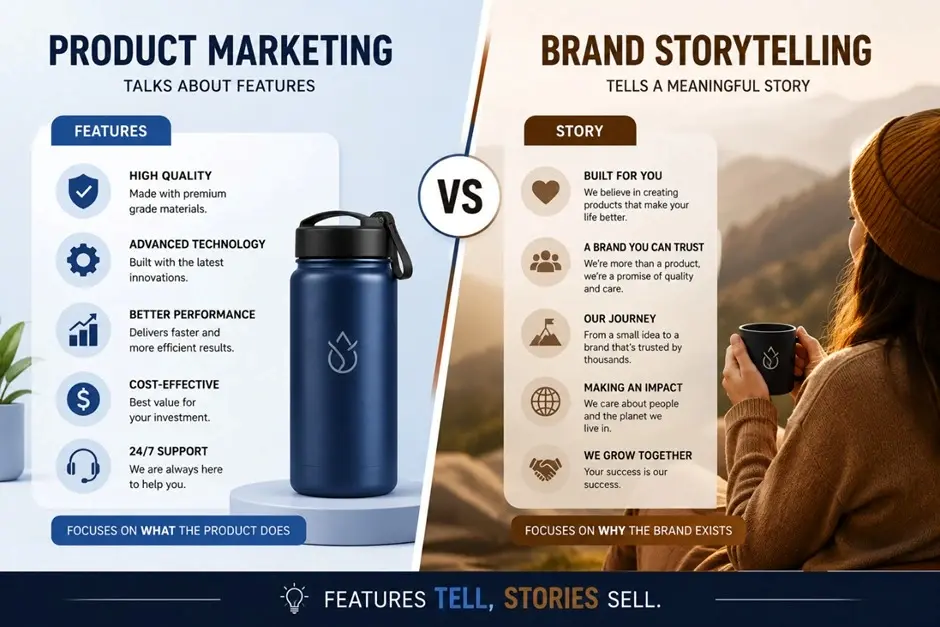
Forget the fancy definition. A story is just not a list.”We have 47 features” that’s a list. “Our founder built this after getting laid off with two weeks of savings” that’s a story. Your brain handles those two things in completely different ways. One makes you compare. The other makes you feel something.
And here’s the uncomfortable truth about buying decisions: they’re mostly feeling. Even the ones that go through spreadsheets and procurement committees. People justify with logic but they decide with gut. Stories get into the gut. Feature lists don’t .Nobody ever texted a friend a pricing table. But people forward stories without even thinking about it.
Why This Matters More Right Now
Feeds are drowning in AI content. Not terrible content, just content that was clearly made rather than lived. You can feel it when you read it. Polished, well-structured, completely empty.
What AI cannot produce is a specific thing that actually happened. A real moment. A detail that only exists because someone was actually there. That specificity is the only thing cutting through right now.
There’s also a search problem that people aren’t thinking about. B2B buyers are using AI tools to do their first round of research before they ever talk to anyone. If your brand story only lives in one video or one landing page, those tools won’t find it. Your story has to be everywhere or it’s basically nowhere.
And people’s trust radar has gotten sharper. Too many inflated promises. Too much content that reads like it was assembled. A story with real friction in it, something that was actually hard, someone who actually struggled registers completely differently. The bar for what feels real has gone up.
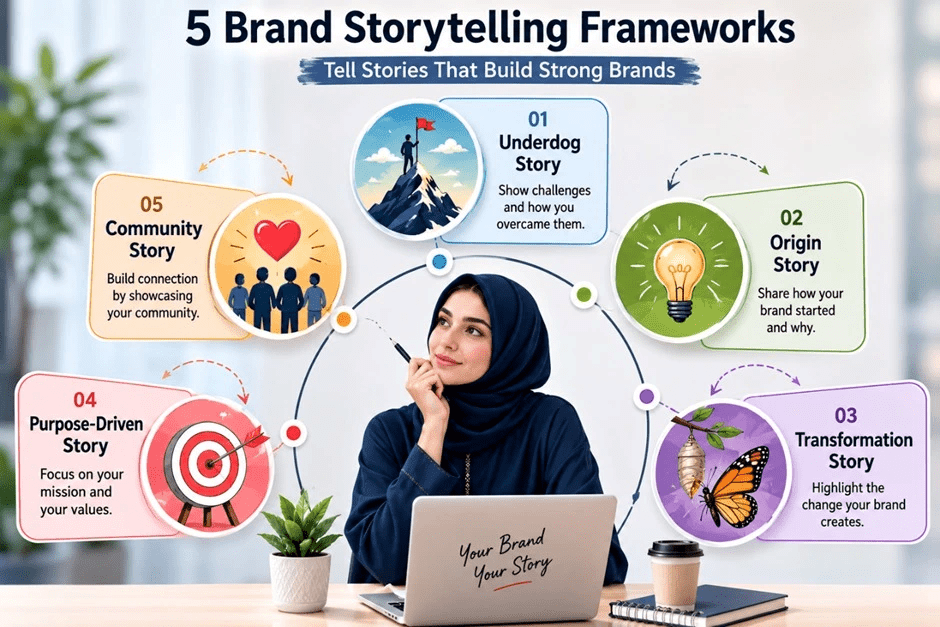
Five Shapes That Almost Every Good Brand Story Uses
Most great campaigns fit one of these five. Worth knowing before getting into the examples.
The Underdog Story: brand starts behind, finds a way to win. Works because most people feel like underdogs somewhere in their own life. A polished success story doesn’t have that same hook; there’s nothing to hold onto.
The Origin Story: why the company exists, traced back to a specific moment when the founder hit a wall. Most overused. Most badly told. Brands strip out every rough edge and end up with something so clean it means nothing. The friction is the whole point.
The Transformation Story: customer before, customer after. Brand is the guide that helped it happen. The second the brand tries to be the star, this whole thing collapses.
The Purpose-Driven Story: brand stands for something beyond the product. Only works when that something shows up in real decisions not just in the campaign brief. People can smell the difference between a costume cause and a real one.
The Community Story: brand steps back, customers talk, brand amplifies the best of it. The only framework that scales without the brand producing everything. Also the hardest to start because it requires real community first.
12 Campaigns. What Actually Made Each One Work.
1. Nike: The Everyday Athlete
At some point Nike stopped making ads about professionals and started making ads about the rest of us. The person lacing up for the first time in three years. The person pushing through something that has nothing to do with medals. The shoe barely shows up. Effort is the product.
Why it works: specific enough to feel real, broad enough that almost anyone finds themselves in it. Holding both of those at once is genuinely hard and most brands never figure out how.
2. Apple: The Quiet Partner
Apple doesn’t show you specs. It shows you a music teacher in a small classroom. A filmmaker working on almost nothing. A designer at her kitchen table at 11pm. The laptop is just open in the background. Nobody mentions what it does.
Why it works: you’re not being sold to. You’re watching someone who looks like you doing something that matters. The product earns its place in the frame instead of demanding your attention.
3. Dove: Real Beauty, Real Bodies
Started in the early 2000s. Still running a version of the same message today. Real people, no retouching, no professional models. Stumbles along the way, yes. But the core hasn’t moved in twenty years.
Why it works: one campaign about authenticity is forgotten in a quarter. Twenty years of the same idea starts to feel like part of what the brand actually is. That weight accumulates. You can’t manufacture it quickly.
4. Airbnb: Belong Anywhere
Before this campaign Airbnb was trying to beat hotels on price. Losing argument. After that, they weren’t competing with hotels at all. They were selling something hotels structurally can’t offer, actually living somewhere for a week instead of visiting it. Real host stories replaced the produced photography.
Why it works: they changed the question. Not “why us instead of a hotel?” but “do you want to visit a city or actually live in it?” Hotels have no answer to the second question.
5. Patagonia: Don’t Buy This Jacket
Full-page ad. Asked people not to buy a jacket they didn’t need. Should have been a disaster. Wasn’t because by the time that headline ran, Patagonia had years of repair programs, a used-gear marketplace, and actual legal fights for the environment behind it. The ad was just the most visible tip of something already real.
Why it works: the story matched the company. Actually matched it, not aspirationally. When they match, people feel it. When they don’t, people feel that too and they screenshot it.
6. Coca-Cola: Share a Coke
Swapped the logo for people’s first names. That’s it. No new product. No new formula. Just your name on the bottle. People bought multiples. Photographed them. Mailed them to people. Generated millions of dollars of content nobody paid them to make.
Why it works: the brand handed people the ending and got out of the way. The story was written because people were living inside it. You can’t really plan that you can only set it up.
7. Slack: Work, Not Software
Slack’s marketing almost never mentions features. No integration counts. No uptime percentages. The stories are about how teams got through hard things, how remote groups stayed close, how actual work got done. The tool is just quietly there.
8. GitHub: The Rubber Duck
GitHub’s mascot is a rubber duck. Means nothing if you’re not a developer. If you are, you get it immediately: rubber duck debugging is a real thing, and it’s a very developer way of thinking through a problem.
Why it works: GitHub picked its audience. That audience felt picked. Big difference.
9. Monday.com: The CGI Llama
Monday.com ran campaigns with a CGI llama. No productivity metaphor. No connection to project timelines. Just a strange, high-energy animal doing office things. In a category where every ad looks like a whiteboard meeting stock photo, the llama is impossible to forget.
Why it works: you don’t need your ad to make complete sense. You need people to remember your name when they’re ready to buy. Weird and fully committed beats safe and polished every single time.
10. Fiverr: The Musical
A Broadway musical. About freelancing. With choreography and original songs. In a category where everyone else is running testimonials and pricing grids. Genuinely strange.
Why it works: going all the way in one direction always beats going halfway in a sensible one. A slightly unusual ad reads like a mistake. A fully committed unusual ad reads like a brand that knows exactly what it’s doing.
11. Notion: The Community Did It
Notion barely makes content about itself. What it does is find the people building remarkable things inside the product full of business operating systems, public wikis, elaborate dashboards and puts those in front of more people. It curates instead of creates.
Why it works: one team cannot write a thousand genuine use cases. Users can, and will, if you give them a reason and a home for it. Notion built infrastructure for other people’s stories instead of trying to tell all the stories itself.
12. Semrush: Just Proof
Semrush doesn’t do any of the above. Specific problem, specific fix, here’s how the tool handles it. No mascots, no swings, no community plays. Just evidence.
Why it works: match the format to who’s reading it. Technical buyers doing keyword research don’t want a charm , they want to know if it works. A creative-heavy approach aimed at that audience would make them trust you less, not more.
What Keeps Showing Up Across All of Them
The brand is never the main character. Every strong example here puts someone else at the center. Customer, founder, community member, audience stand-in. The brand guides and supports. It doesn’t start. This is the most common mistake and one of the hardest habits to actually break.
Consistency matters more than any individual piece. Dove’s twenty years. Patagonia’s years of actual work before the famous ad. Nike’s decades of athlete storytelling. None of it was built with one campaign. It was built by saying the same true thing, in different forms, until it became part of what the brand means to people.
Specific always beats broad. The rubber duck, the musical, the llama each one works because somebody committed to something specific and strange instead of something safe. Safe and broad is forgettable. It’s also what most brand marketing looks like.
The story has to match reality. Patagonia’s ad worked because the programs were already real. Run that headline without the years of work behind it and watch what happens. People dig now. They screenshot. They share receipts.
Seen enough examples? Time to build your own. bestdigitalmarketingtrends.com has more frameworks and breakdowns to help you get there.
How to Build This for Your Own Brand
Step 1: Pick the framework that matches your actual history
Not the one that sounds best, the one that’s true. Started the company because you kept hitting a wall nobody had solved? That’s an origin story. Tell it with the friction, not without it. The rough edges are the point. Customers who actually transformed using what you built? Transformation stories let them tell it in their words, not yours.
Step 2: Find where the real tension is
Every example in this article has actual conflict at its center. Dove against beauty standards. Patagonia against overconsumption. Nike against self-doubt. Without that tension it’s not a story it’s a description. Keep digging until you hit something that was genuinely hard.
Step 3: Put the customer in the lead role
Pull up your About page right now. Read it like you’ve never heard of the company. Does it sound like a brand listing its own accomplishments, or does it sound like someone talking about a problem the reader actually has? Most pages sound like the first thing. Rewrite it until it sounds like the second. Harder than it sounds. Most brands never quite get there.
Step 4: Think in years
Dove didn’t build anything in one campaign. Neither did Patagonia. Neither did Nike. They built it by showing up with the same true thing, across different formats, year after year, until it started to feel like part of what they are. One campaign is a campaign. A brand story is what accumulates.
Step 5: Put the story everywhere someone might look
Buried on a launch page means found by nobody. Homepage, about page, social bios, case studies, pitch decks, onboarding emails the same thread, everywhere. Human researchers need to find it. AI tools doing early research need to hit it. It should show up the same way no matter where anyone looks.
Mistakes Worth Naming
Running one campaign and wondering why nothing changed. Storytelling isn’t a campaign. It’s what the brand means over time. Time is the ingredient you can’t skip.
Writing about the brand instead of the customer. “We’re passionate about business growth” is about you. “Here’s someone who doubled revenue in eight months and here’s exactly what shifted” is about her and every reader who wants what she has.
Claiming values before you’ve done the work. Purpose campaigns only hold up when the actions come first. Announce the values before the work and the backlash travels further than the original claim ever did.
Softening the creative until it offends nobody and interests nobody. The campaigns that broke through committed fully to something specific. Half-commitment to a bold idea reads as a mistake. Full commitment reads as confidence. There’s a big difference.
FAQs
What actually is brand storytelling?
Using a story instead of a list to say who you are and why it matters. Not what you do, who you are. Different question.
Why look at examples instead of just reading theory?
Theory gives you the shape of good work. Examples show you what it feels like to be on the receiving end of it and what it feels like when it doesn’t land. You learn different things from each.
Do you need a budget?
Not much. GitHub’s mascot is an idea, not a line item. Fiverr’s musical cost something but the weird premise is what made it work, not the spend. A small brand with a specific honest story beats a large brand with a vague one more often than people expect.
How long until it works?
Longer than one campaign. The brands that built something durable did it by repeating a true thing long enough that people started associating it with them automatically. No faster version exists.
The most common mistake?
Making the brand the hero. Every strong example here puts someone else in that role. The brand helps. It doesn’t start.
Can small businesses do this?
Yes and they often have an advantage. The founder is usually still there. The origin is recent and real. The customers are close enough to actually talk to. Everything needed for a genuine story is usually already present. It just hasn’t been written down yet.
Final Thoughts
The budget didn’t build any of these brands. Clarity did. Nike knows it’s not selling shoes in its best work. Patagonia knows it’s not really selling jackets. They figured out something true and said it across every format, every channel, for years until it became what people think of when they hear the name.
One real conflict. Told honestly. Repeated everywhere the brand shows up. That’s the whole thing and it costs less than most people think.
That’s the whole thing and it costs less than most people think. For more no-fluff marketing breakdowns like this one, visit bestdigitalmarketingtrends.com.

