
You spend six hours on a post. You hit publish. Then nothing. A few days later you check, and the only reader is you.
It stings, and it happens a lot. The post usually isn’t terrible. People just never saw it. A content distribution strategy fixes that. Below you’ll find the three kinds of channels, a quick plan for each post, and two sets of rules you shouldn’t skip. Facts from official sources are labeled. The rest is my opinion.
What a content distribution strategy is!
It’s a plan for getting your work in front of people after you make it. That’s it. Writing is half the job. Sharing is the other half, and most of us do it badly.Picture a food truck. Great tacos still won’t sell on a dead street. Your content distribution strategy is how you pick the busy one.
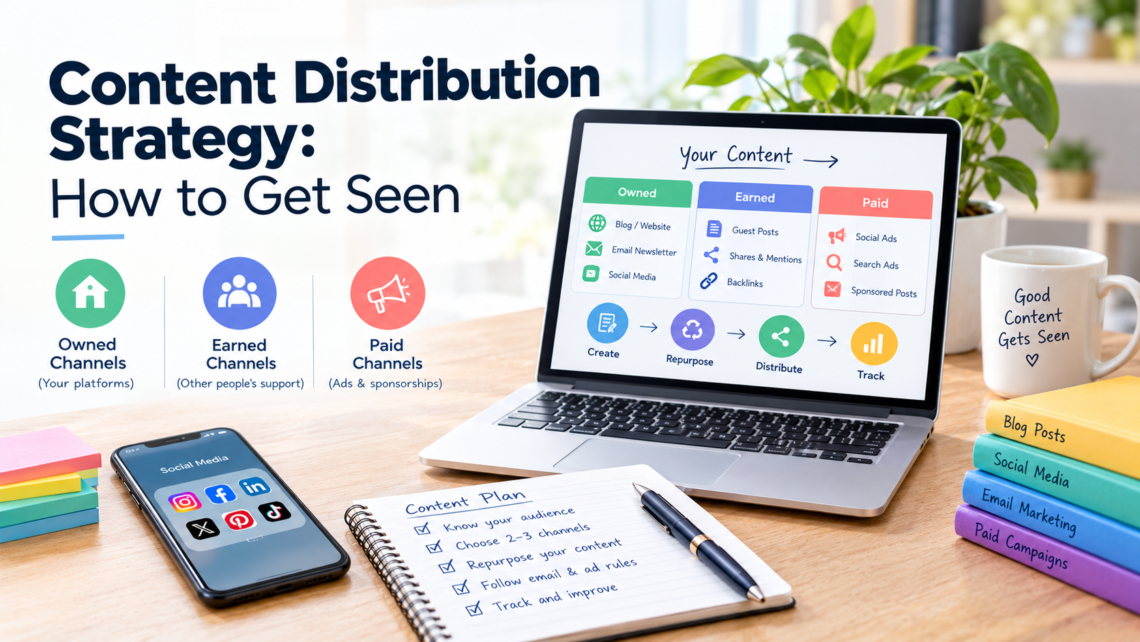
Owned, earned, and paid
It is quite normal for marketers to divide their channels into three categories. It is a practice, nothing formal.
Owned channels are channels that are owned by you. Your blog, your mailing list, your social media sites. No one can shut them off on a whim, but you have to develop an audience for them.
Earned channels are where other people promote you. A guest post, a share, a mention and a link from another site. It cannot be bought, you earn it.
Paid channels cost money for reach. Ads and sponsored posts are the usual ones.
Most small teams should lean on owned first. It’s the cheapest. A decent content distribution strategy mixes all three over time.
Step 1: Find out where your readers hang out.
Start off with a basic question. Who is reading your content and where are they currently?
Are you using analytics on your site? Check out where they’re coming from. If not, ask. Send a message to three current readers/customers and ask them, “Where do you go to learn about this stuff?” Your answers will come back before lunchtime.
Say you write about home baking. Your readers might live in a few Facebook groups and one video app. That’s useful.You know now where you need to go. Choose two or three channels for distributing your content rather than ten, for trying to reach all places will only exhaust you.
Step 2: Write a five-line plan for each post.
Do this before you hit publish, not after. Grab a note and answer these:
- Who is this for?
- What do I want them to do next?
- Which two or three channels will I use?
- What format works on each?
- When will I share it again?
That takes around five minutes. Bypass it and you’ll wind up joining many other people who only post once and then forget about it.
Step 3: Reuse one post a few ways.
You don’t need a new idea for every channel. Take the one you have and bend it.
Let’s say you wrote a long guide to sourdough. You could film a 30-second clip of the one tip people always get wrong. You could turn five tips into a carousel. A few lines could become short posts, and one section could go out in your email.
One idea, four shapes. But don’t just paste the link everywhere. A big wall of text in a social feed gets scrolled past. People on each app expect something different. Topics that stay useful for months are the easiest to reuse, and our evergreen content ideas guide helps you find them.Also, share your best posts again a few weeks later. Lots of people missed them the first time.
Step 4: Use email, but follow the rules.
Email is owned. It reaches people who asked to hear from you. It also comes with legal rules.
The Federal Trade Commission’s CAN-SPAM guide for businesses lists the main ones for commercial email:
- Never mislead recipients through false header information.
- Do not mislead recipients through deceptive subject lines.
- State that the email is an advertisement clearly and conspicuously.
- Clearly disclose your location.
- Provide clear instructions about how a recipient may opt out, and honor opt outs promptly.
- Take responsibility for all communications done through agents.
This document indicates that there are 10 business days to comply with the opt-out request. It also states that each violation of the CAN-SPAM Act via email can incur a fine of up to $53,088. This document was last updated in January 2024 after being published in August 2023.
Business emails are not necessarily treated the same. I am not a lawyer. If you send many business emails, consider having one checked by a professional.
Step 5: Be upfront when you work with others.
Earned and paid channels often mean working with creators or partners..
As per the disclosure guideline by the FTC regarding social media influencers, one must disclose any financial relationship, any sort of employment, personal connection, or familial relationship with the brand. Even giving out the free products counts, not just money. This disclosure must be clearly visible and appear alongside the promotion. Posting such a disclosure on your profile page or at the end of the posting or even after the “MORE” button will surely be missed. If the promotion appears in a video, the disclosure must be made within the video itself.
“Advertisement”, “ad” or “sponsored” must be used and not any vague terms like “sp”, “spon” or “collab”. The guideline has been released in November 2019 and was last updated in December 2024.Inform your partnering brands about that.
Step 6: Set a weekly routine for your content distribution strategy.
A plan only helps if you use it. Here’s one rhythm. It’s just my idea, so move things around.Monday, publish the post. Tuesday, share it on your best channel. Wednesday, send it to your list. Thursday, post a short clip or tip from it. Friday, answer comments and jot down what worked.Five small jobs. No big campaign. That’s the whole content distribution strategy for one week.
Step 7: Keep score, simply
Forget the slick dashboard. With each piece of content you produce, track where people come from and what they do there. Are they reading? Signing up? Sharing?
Within a couple months, once you’ve been tracking how you distribute your content, trends emerge. There are places that work and those that don’t. Focus more on the former.No need for industry benchmarks, because what’s good is dependent on your particular niche and size.
Common mistakes with a content distribution strategy
- Posting once and moving on. Most posts deserve more than one share.
- Trying every channel. A few done well beat a dozen done badly.
- Pasting the same text everywhere. It reads lazy because it is.
- Ignoring comments. If people reply, answer. That’s free reach.
- Skipping the rules. Email and paid work have legal requirements, so learn them early.
Your next step
Grab your latest post. Write the five-line plan from Step 2. Pick two channels and share it this week in two different formats.Then browse our content marketing posts for more. A good content distribution strategy isn’t about doing more. It’s about getting solid work in front of the right people, more than once.
FAQ
What is a content distribution strategy?
It is the strategy that explains the process by which you will distribute your created content. This includes the channel selection, the format required and the timing. The lack of this strategy often results in great posts remaining unnoticed.
What are owned, earned, and paid channels?
Your blog and email list are owned. A mention from someone else is earned. Anything you buy is paid.
How many channels should I use?
Try starting with two or three. Then add more once you’ve got your routine down. A thin spread across many people isn’t ideal.
Do I have to play by any rules when I market my content?
Sometimes, yes. There are FTC regulations for commercial email through CAN-SPAM and guidelines for disclosing sponsorships. Not being a lawyer myself, look up the rules that apply to you.


