
Everyone seems to have a friend who “makes content.” A cousin with a cooking channel. A coworker who films gym tips at 6 a.m. Some of them earn a little. A few earn a lot. Most? Honestly, nobody asks.
That gap is the story. Below are the creator economy trends that the numbers actually support, with dates on every figure so you know how fresh it is. I’ll also point out what the data can’t tell us yet.
The creator economy in plain words
It refers to the individuals who make and share videos, notifications, press releases, and audio recordings with the goal of making money. This money from various sources such as companies and users.
Picture a village market. There might be several vendors there, but only some manage to draw customers to them and make profit.
Creator economy trends: how big is it?
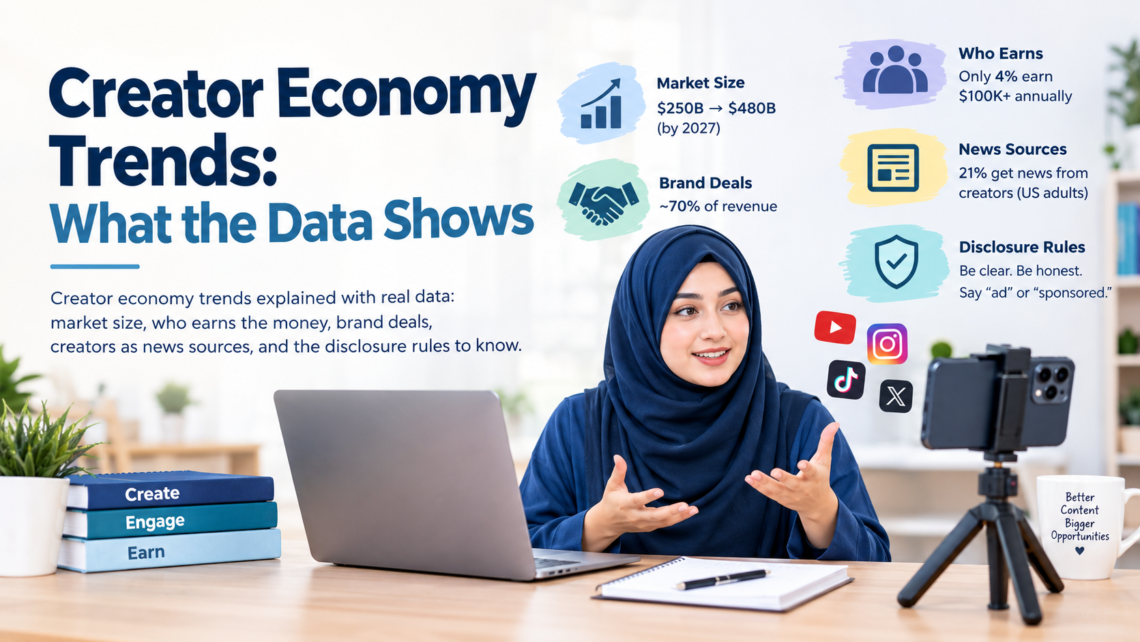
Big and growing, if you trust the forecasts.According to Goldman Sachs Research, the creator economy stood at about $250 billion, with projections of reaching $480 billion by 2027. The organization reported 50 million creators globally and projections of growing at 10 to 20% annually for five years. Those numbers come from a Goldman Sachs article published April 19, 2023.
Two cautions. First, that’s a forecast from 2023, not a count from today. Second, forecasts miss. I’d treat the direction as useful and the exact dollar figure as a rough guess. If you quote it, say where it came from and when. That’s good practice with any creator economy trends you cite.
Creator economy trends: brand deals pay the bills
Where does a creator’s money come from? According to the same Goldman article, brand deals are the biggest source, at about 70% of creator revenue based on survey data. The rest comes from a share of ad revenue on platforms, subscriptions, donations, and other direct payments from followers.
That tells you something about creator economy trends. Most creators depend on companies like yours, not just on fans. When brands pull back their budgets, creators feel it fast.It also means the line between “creator” and “ad channel” is thin. Audiences know it. The best creators keep trust by being picky about who they work with.
Creator economy trends: a small group earns most.
Here’s the number that surprised me.According to Goldman, only 4% of content creators are professionals who earn above $100,000 annually. However, the article does not provide any figures on the number of content creators who actually earn their living through it.
One of the quieter creator economy trends is how uneven the pay is. So when a headline says “50 million creators,” remember most of them aren’t getting rich. Plenty are hobbyists. Plenty are part-timers. A handful are household names. Back to the town market: lots of stalls, a few crowds.
For marketers, this matters. Bigger isn’t always better. If you’re curious about smaller voices, our guide to micro-influencer marketing strategy shows how brands work with them.
Trend three: creators as news sources
I must say that I was surprised. According to the research made by the Pew Research Center called America’s News Influencers published on November 18, 2024, 21% of the adult US population usually gets news from social media news influencers. Among people aged 18 to 29, this percentage even reaches 37%.The Pew Research Center studied 500 of the 28,266 influencers who were selected.
About 77% have no past or present tie to a news organization. So we’re talking about ordinary people with big audiences, not reporters from newsrooms.
What does that mean for creator economy trends? Creators aren’t only entertainers anymore. For many people, they’re also where news and opinions come from. That raises the stakes on trust, and I’d guess it makes audiences pickier about who they follow.I’d be careful not to stretch this one. Pew studied news influencers, not every kind of creator. A baking channel isn’t a news channel.
Trend four: rules and trust
Regulators pay attention when trust, money, and advertising come together. From the guide called “Disclosures 101 for Social Media Influencers,” The FTC state that influencers should properly declare their financial, employment, or personal ties with the company in question. It even regards free products. The disclosure should be hard to miss, and it should sit with the endorsement, not on a profile page or behind a “more” link.
The FTC also warns against vague tags like “sp,” “spon,” or “collab.” Plain words like “ad” or “sponsored” are clearer. And you can’t describe a product you haven’t tried.If you work with creators, this is your problem too. Put disclosure rules in your contracts, and check posts after they go live.
What marketers should do with this
This is not a statement but merely my perspective. Founders should consider creators as collaborative partners in the company’s objectives, rather than as mere advertising platforms. It is better to concentrate on the actions of the audience rather than its volume. Trust that cannot be recreated is a must-have. It is important that one starts small: one creator, one goal, and one authentic outcome. If you achieve what you want, continue following this path. If it doesn’t, you learned cheaply.
Check dates on every statistic you use. Plenty of articles on creator economy trends recycle old numbers without saying so. A figure from 2023 can still be useful, but only if you label it that way.Want the wider picture on social media? Browse our social media marketing articles.
Where it might go next
I can’t see the future, and neither can a forecast. My guess is that creator economy trends will keep leaning toward direct payments from fans, because Goldman already lists subscriptions and donations as income. I’d also guess disclosure rules get stricter in practice, not looser, as more people treat creators as trusted voices. Both are opinions. Watch for new data before you build a plan on them.
Your next step
Select one specific channel or creator in your niche market and identify their sources of income. Analyze what audience they are targeting, as well as how they disclose partnerships. Remember that one observation is better than ten summaries. Use the information gathered to establish your own partnership.
Keep up to date with the happenings in the creator economy without being too naive. Although the market is thriving, it does not mean that the money is flowing evenly.
FAQ
What is the creator economy?
Work built around making content for an audience, paid through brands, platforms, subscriptions, or donations.
How big is this market?
According to Goldman Sachs Research, the number will be close to $250 billion in 2023 and up to $480 billion in 2027. This is a forecast, thus, should be taken as an approximate figure.
How do creators make money?
Mostly from brand deals, which Goldman put at about 70% of revenue in survey data. Other sources include ad revenue shares, subscriptions, and donations.
Do most creators earn a full-time living?
Not by that data. Goldman adds that “roughly 4 percent of content makers were professionals earning more than $100,000 annually.” This statistic does not provide any separate information regarding those making a living from their creations.
Should creators disclose their partnership?
Yes. According to the FTC, one is required to disclose all paid or unpaid relationships with brands, be it a product sponsorship, employment, or family relationship.
