
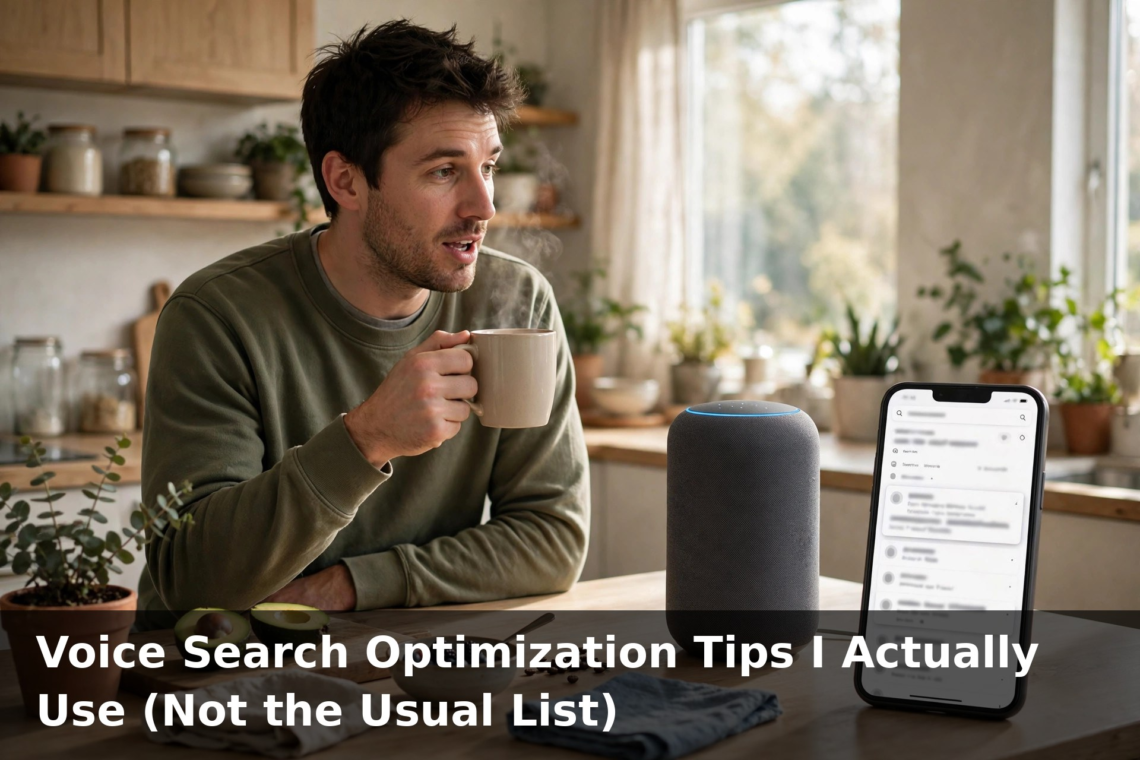
The first time I took voice search seriously, I was in my kitchen with wet hands, mid-recipe, asking my phone where the nearest open grocery store was. It read me one answer. One. Not ten blue links — a single result, spoken out loud, and I went with it because my hands were covered in flour.
That’s when it clicked for me. When somebody types a search, they scan and choose. When somebody talks to a phone or a smart speaker, the assistant chooses for them. And if your page isn’t the one it picks, you don’t come second. You don’t exist. I’ve spent two years testing what gets a page picked. Half of what I tried did nothing. This post is the other half.
Start with how people actually talk, not how they type
Typed searches are lazy. “Best pizza near me.” Three words, no grammar, done. Spoken searches are full sentences, because talking costs nothing extra. “What’s the best pizza place near me that’s still open?” Same person, completely different query.
So the first of my voice search optimization tips is boring but it works: write your headings as the questions people would say out loud. I went through a client’s services page last year and changed flat headings like “Our Pricing” into “How much does it cost to…?” style questions. Nothing else changed. Within a couple of months that page started showing up for spoken-style queries it had never touched before.
My keyword research changed completely
I used to build keyword lists around short phrases. Voice search seo tips forced me to flip that. Now I hunt for long, conversational phrases — the ones stuffed with question words. Who, what, where, how, when, why, near me.
Where do I find them? The “People Also Ask” boxes are a goldmine, and they’re free. I also keep a note on my phone of questions clients ask me on calls. If a customer said it to me on the phone, somebody has said it to Siri in their car.
The answer has to come first, and I mean first
Here’s a mistake I made for months. I’d write slow introductions — set the scene, get to the point around paragraph four. Fine for a post somebody’s reading with coffee. Terrible for voice.
A voice assistant wants a short, clean answer it can read aloud, a sentence or two. So now, under every question heading, my first lines answer the question directly. Then I expand underneath for the humans who want depth. But it works, and readers don’t mind either — plenty of them are skimmers anyway, let’s be honest.
Featured snippets are the real prize
When Google shows a featured snippet at the top of the results, that’s very often the exact text a voice assistant reads out. Not always, but often enough that I treat snippets as the whole game.
What gets my pages into snippets? Short definition-style paragraphs right under a question heading. Numbered steps as plain sentences when the question is a “how to.” No fluff in the first forty or fifty words. I had one how-to page that sat at position three for ages. I rewrote the top so the opening answer was two sentences instead of five. It took the snippet. Traffic didn’t explode — I won’t pretend it did — but the voice traffic followed.
Conversational keywords don’t mean sloppy writing
There’s a trap here I fell into once. Early on, I thought conversational search meant writing the way people talk — filler words, half-finished thoughts, “um” energy. I rewrote a landing page like that. It read terribly and converted worse.
Conversational means natural sentence structure and everyday words, not a transcript of someone thinking out loud. Read your draft out loud. If you stumble over a sentence, a voice assistant will too. If it sounds like something you’d say to a customer across a desk, you’re close.
Local searches are where voice really earns its money
Think about when people talk to their phones instead of typing. Driving. Walking. Cooking, like me with the flour hands. A huge share of those moments are local. That’s where voice assistants marketing talk stops being theory and starts being revenue.
My checklist here is unglamorous. Google Business Profile complete, hours kept current (wrong holiday hours will quietly kill you), the same name, address and phone number everywhere, and a page that answers “where are you and when are you open” in plain words. I once found a client’s site listing an old address two years after they’d moved. The assistant was sending people to an empty unit.
Slow pages don’t get read out loud
Page speed matters for all SEO, but voice adds a wrinkle. Assistants pull answers from pages they can process fast, and people talking to a phone are in a hurry. A page that takes six seconds to load on mobile is out of the running before the race starts.
I’m not a developer, so my fixes are the simple ones. Compress images instead of uploading camera originals. Cut the plugins nobody asked for. Test on your own phone, on mobile data, not office wifi — that one stings the first time. Every site I’ve sped up has done better across the board, voice included.
Write for one question per section
A page that tries to answer five questions in one rambling section gives the assistant nothing clean to grab. I structure pages so each section answers one question, fully, and then stops.
Does it mean more pages sometimes? Yes. I’d rather have three focused pages, each owning a question, than one giant page that owns nothing. I learned that the hard way after merging content into one “ultimate guide” and watching it lose the specific queries it used to win. Merging felt efficient. The results disagreed.
Schema helps, but it’s not magic
Structured data — FAQ schema, local business schema — gives search engines a cleaner map of your page. I add it where it fits, especially FAQ sections, because voice search runs on questions and answers.
But. I have seen people spend a week on schema for a page with thin, muddled content, expecting a miracle. Schema describes good content; it doesn’t replace it. Get the words right first, then mark them up.
Test it yourself, on your own phone, like a customer
The most useful of all my voice search optimization tips costs nothing and almost nobody does it. Pick up your phone. Ask it the questions your customers ask. Is it your page that answers? A competitor’s? Something from 2017?
I do this every few months for my main pages, standing in my kitchen like a lunatic, talking to my phone. Half my content ideas come from hearing the assistant read a competitor’s answer and thinking — I can beat that.
Your next step
Don’t rebuild your whole site this week. Pick one page — your best service page or your most-visited post — and do three things. Rewrite its headings as spoken questions. Put a short, direct answer under each one. Then ask your phone those questions and see what happens. Best Digital Marketing Trends shares practical insights to help you adapt to changing search trends and improve your content strategy. That’s an afternoon of work. It’ll teach you more than a month of reading — including this post, honestly.
FAQ
How is voice search different from regular SEO?
The basics are the same — good content, fast pages, clear structure — but voice queries are longer, phrased as full questions, and the assistant usually reads out one answer, often the featured snippet. You optimize for being the single best answer, not one of ten links.
Do I need separate pages just for voice search?
No, and I’d advise against it. The same page serves both if it’s structured well: question headings, a short direct answer up front, then detail underneath. One strong page beats two thin ones.
Which voice assistants should I optimize for?
Start with Google — Assistant pulls from the same results and snippets you’re already working on. Siri leans on web results too, and Alexa draws heavily on Bing, so solid all-round SEO covers most of it.
How long does it take to see results from voice search optimization?
Snippet wins show up in weeks to a few months, not days. Track it in Search Console by filtering for long, question-style queries — that’s where the movement shows first.


