
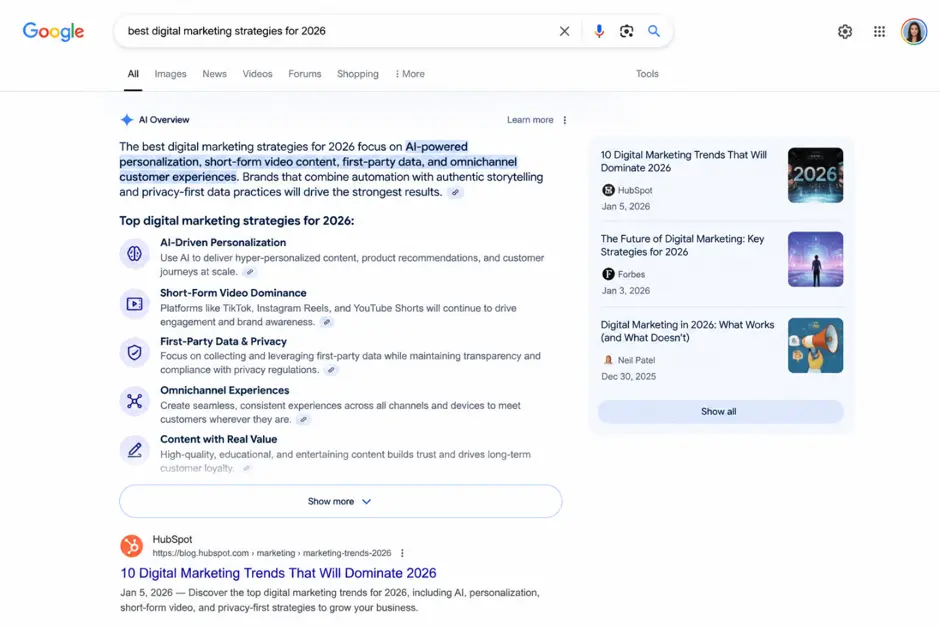
You put in the work. Research the keywords. Wrote a solid article. Got it to page one. Then Google rolled out AI Overviews and your traffic dropped anyway. That’s not a hypothetical. It’s what happened to thousands of sites in 2025. Ranking isn’t enough anymore. If Google’s AI summary answers the question before a user ever reaches your link, the click never comes.
And here’s the part most people don’t know yet: brands that do get cited inside AI Overviews earn around 120% more organic clicks per impression than brands that rank on the same page but don’t get cited. Being in that summary and being below it those are two completely different traffic outcomes. So this is a guide to what’s actually changed, what the numbers show, and what to do about it.
Why traditional SEO isn’t enough anymore
For years, the goal was simple: get to page one, get the clicks. That model is breaking down. Position 1 click-through rate drops by 58% when a Google AI Overview is present. That means ranking first on Google, a result that may have taken months of work delivers less than half the traffic it would have before AI Overviews took over the top of the page.
The numbers back that up across multiple studies. When an AI Overview appears in search results, only 8% of users click any organic result at all. Without an AI Overview, that number is 15%. One SERP feature, and click behaviour nearly cuts in half.
What Google AI Overviews actually are
Google AI Overviews are AI-generated summaries that appear at the very top of search results above the traditional blue links. They’re generated by Gemini, Google’s large language model, based on information pulled from indexed websites and other sources of data, including the Knowledge Graph.
Google doesn’t pull from one source. It reads multiple pages, blends the most relevant information together, and writes a combined answer. Then it lists citations below. If your page gets cited, your part of the answer. If it doesn’t, you’re competing for whatever clicks remain below the summary.
AI Overviews appear when the query is best answered by combining information from several sources, mostly informational intent. Transactional queries like “buy X near me” and navigational queries almost never trigger one. Commercial comparison queries are a mixed middle ground. Informational pages guides, how-toss, explainers, comparisons are where almost all AI citations happen. If that’s most of your content, this matters a lot.
How to optimize content for Google AI citations
AI engines don’t read your whole page equally. Whatever you put near the top gets the most attention. So answer the question in the first 50 words, not the 500th. If the question is “What is answer engine optimization?”, your first sentence should be “Answer Engine Optimization (GEO) is the process of, don’t warm up the reader first. Old SEO let you build up to the point. AI citation doesn’t. Put the answer first. That’s the biggest writing change you need to make.
Keep answer paragraphs between 134 and 167 words
The ideal length for main answer paragraphs is between 134 and 167 words. This is the preferred extraction and summary length for large language models. Write tighter than that and you may not provide enough context. Go much longer and the AI may pull a fragment instead of the full answer.
Add schema markup
For AI Overviews specifically, schema is like a cheat code. Key schema types to add include Article, FAQ, How-to, and Organization. Most SEO plugins handle schemas automatically. The important thing is actually using it.
Update content on a regular schedule
Google’s AI actively weights content recency. Set a quarterly refresh cadence for your AI-priority pages: update statistics, refresh examples, and republish with a visible new date. The timestamp is visible in AI Overview citations users can see when your content was last updated, and so can Google’s ranking systems. A page that hasn’t been touched in 18 months is quietly losing ground. Not in rankings necessarily but in citations, which is where the traffic growth is now.
Build internal linking around your topic clusters
Google’s AI evaluates topical authority partly through your internal linking structure. A page that’s well-linked from related content on your site signals that it’s the authoritative treatment of that topic within your domain. Build tight internal link networks across related pages. This isn’t new SEO advice. But it matters more now because AI systems look at your whole site, not just
AI content strategy: what actually works in practice
Optimizing for AI citation requires a shift in how you approach content planning, not just how you write individual pages. Fewer, deeper articles beat a high volume of thin ones. A site with 200 shallow posts is less likely to earn AI citations than a site with 40 that actually cover the topic. That’s a real shift from how a lot of content teams have operated for the past decade.
Original data helps more than most people realize. Nobody else can reproduce your numbers. And don’t ignore your transactional pages. Product pages, service pages, commercial comparisons these are much less affected by AI Overviews because those queries almost never trigger one. The traffic from commercial intent searches is still high-click and worth protecting.
AI marketing examples: brands doing this well
A few real cases worth looking at:
HubSpot’s marketing blog is the clearest example. They’ve published detailed, structured guides on specific topics for years before AI Overviews existed. Their content maps to search intent, uses clear headings, and answers questions directly in the opening paragraphs. Google cites them regularly now not because they optimized for AI, but because they were already writing the way AI systems prefer.
Adidas and Lenovo are real examples of brands using AI production tools at scale. Averi cites both as companies that saved significant time on content workflows while keeping quality consistent. The lesson isn’t that AI wrote their content. It’s that AI handled the routine parts so the humans could focus on the parts that needed judgment.
Best AI content creation tools for 2026
If you’re building or scaling a content operation in 2026, these are the tools worth knowing.
For writing and SEO optimization
SEMrush’s Content Toolkit is worth knowing if you want SEO and content production in one place. It handles topic discovery, brief generation, and article optimization and cuts down the research time significantly before you write anything.
Jasper works well for teams where multiple people are creating content and brand voice consistency is a real problem. You upload examples of your best writing, it learns the pattern, and outputs stay closer to your standards than a generic AI tool would. Pricing starts around $49 per seat.
For AI visibility tracking
The SEMrush AI Visibility Toolkit tracks your brand’s AI visibility, evaluates it against competitors, and surfaces which URLs AI tools are citing in their responses. If you’re not tracking AI citations yet, this is a sensible starting point.
Aires focuses specifically on AI search visibility. Tools like Aires Insights track which pages appear in Google AI Overviews and surface the structural and authority signals that correlate with inclusion.
Brandi is newer and worth watching for competitive intelligence. Rather than content creation, Brandi zeroes in on visibility in tools like Catgut, Gemini, Perplexity, and Google AI Overviews tracking your “AI share of voice” to show how often your brand is mentioned, cited, and positioned across real buyer-intent prompts.
AI branding tools: staying consistent as output scales
The problem isn’t the AI writing. It’s that when twenty people are using the same tool with no shared guidelines, the output starts to drift. One person’s version of your brand voice sounds nothing like another’s.
The split that works: AI handles research, structure, and first drafts. A human adds the experience, the opinion, the detail that only comes from actually knowing the topic. When that’s working, you can produce a lot of content without it all sounding the same.
AI social media marketing tools
If you run social media for a brand, AI tools have probably already changed how much you can produce in a day. The bigger shift is in what kind of work you’re doing: less time on first drafts, more time on judgment calls about what’s actually worth posting.
Jasper and Copy.ai can produce caption drafts, LinkedIn posts, and ad copy quickly. The output is usable but rarely great without editing; the tone tends to flatten out after a few pieces. Worth using as a starting point, not as a finish line.
The more important point about social media in 2026: it functions as a distribution layer for content produced elsewhere, and AI Overviews don’t touch it. Social is one of the few places where your reach isn’t affected by Google’s AI. Building at least one owned channel email newsletter that is not dependent on Google’s click economy is worth prioritizing alongside social.
What to track now that rankings tell only half the story
Google Search Console will show you impressions on queries where AI Overviews appear even when traffic doesn’t follow. That gap between impressions and clicks is the number worth watching. If you’re getting thousands of impressions and almost no clicks on an informational query, there’s a good chance an AI Overview is answering it and your page isn’t being cited.
For more granular tracking, tools like SEMrush’s AI Visibility Toolkit, Aires, and Brandi show specifically which of your pages are being cited inside AI platforms, and where you’re not showing up but should be. Manual spot-checking, searching your target keywords and looking for your site in AI Overview citations takes five minutes and is free.
The metric shift is real. Organic traffic is a lagging signal now. AI citation rate is the leading one. A page that’s getting cited today will compound in traffic as those queries grow.
For[bestdigitalmarketingtrends.com, the practical starting point is auditing which existing pages target informational queries and updating them to meet the structural requirements outlined above. Pages that already rank but aren’t getting cited are the highest-value targets.
The honest take on Google AI search optimization
Most of what earns AI citations is the same stuff that made content good before AI Overviews existed: answer the question directly, be specific, use real sources, keep things current. The practices haven’t changed as much as the urgency has.
What’s changed is the urgency. Google search referral traffic to publishers declined globally by about a third in the year to November 2025. That’s a real number. Waiting it out isn’t a strategy.
The sites holding steady right now publish fewer articles, not more. They write for people first and structure for AI second. They track where their content is getting cited, not just where it ranks. And they’ve stopped treating email lists and newsletters as nice-to-haves because owned audiences don’t depend on what Google does next week.
That’s the whole adjustment. None of it is complicated. Most of it is just doing what good content was always supposed to do and actually finishing it.
FAQ
Google AI search optimization also called GEO (Generative Engine Optimization) is about getting your content cited inside Google’s AI Overviews. These show up at the top of search results for most informational queries. It’s different from regular keyword SEO because the focus is on how clearly your content answers a question, how well it’s structured, and whether AI systems can actually pull a clean answer from it.
AI Overviews appear above organic results and answer many queries directly. Studies show organic click-through rates drop 50–61% on queries where an AI Overview is present, regardless of your ranking position. If your content isn’t being cited inside the overview, you’re competing for a smaller share of remaining clicks.
Check Google Search Console for impressions on queries where AI Overviews appear. For deeper tracking, tools like SEMrush’s AI Visibility Toolkit, Aires, and Brandi monitor which of your pages are being cited across AI platforms. Manual checks searching your target keywords and looking for your site in AI Overview citations are also useful and free.
Transactional and commercial content product pages, comparison pages, service pages, branded searches are significantly less affected because these queries rarely trigger AI Overviews. Optimizing these pages remains a high-priority, high-click-value activity in 2026.
Partly. The fundamentals haven’t changed, quality, authority, and relevance still drive citation. What’s changed is the execution: lead with the answer, structure content in self-contained sections, use schema markup, keep pages updated quarterly, and track AI visibility alongside traditional rankings. Sites that adapt these practices see better results across both AI and traditional search.
Conclusion
In the end, Google AI search optimization isn’t a separate discipline from good content. It’s the same fundamentals: clear answers, real sources, current information applied with more urgency than before. AI Overviews aren’t a temporary feature that’s going to fade out. They’re how search works now, and they’re only expanding.
What separates the sites holding their traffic from the ones losing it isn’t some secret technical trick. It’s that the winners answer the question early, structure their pages so both people and AI can scan them, and actually keep their content updated instead of letting it sit for two years. They’re also building audiences that don’t depend entirely on Google, an email list, a newsletter, something that’s theirs regardless of what the next algorithm update does. AI search is moving fast and most advice online is already out of date. bestdigitalmarketingtrends.com covers what’s actually changing in digital marketing
Disclaimer
The stats and tool mention in this article come from publicly available data and industry reports as of 2026. AI Overview coverage shifts often, and so does search behaviour. What works in one niche may not work in another your results will depend on your content type, domain history, and how competitive your space is. Nothing here is a guarantee. Test things on your own site and see what the data tells you.
