
You publish a blog post. It’s decent. Keyword’s in the title. You wait. Nothing.This happens all the time and the fix is almost always the same. One post doesn’t move the needle anymore. Google looks at the whole picture on every page, every topic you’ve covered and decides whether your site actually knows what it’s talking about.
Google’s Helpful Content guidelines make this explicit content written primarily for search engines rather than real people gets demoted. Every post you publish should answer a real question someone actually has, not just tick an SEO box
That’s topical authority SEO, and it ranks among the biggest factors in modern search.That’s the part most people skip. Two sites, same niche, same output totally different results. Topic selection is almost always why. If you’re starting from scratch, our keyword research guide for beginners walks you through finding the ones worth going after.
What Is Topical Authority in SEO and Why Does Google Care?
Google trusts some sites on certain subjects more than others. It’s got nothing to do with how many posts you’ve published. How deep you’ve gone on a subject. You’d trust that person over someone who skimmed one article about oil changes. Google works the same way.
A site with 20 tight, connected posts on one subject regularly beats sites with 200 posts spread across everything. Volume without focus is mostly wasted effort.
Why It Matters More Right Now
This didn’t flip overnight. Google has been pushing in this direction for years but the June 2025 core update was the point where you couldn’t pretend otherwise anymore. Sites with deep, connected content on a subject got a boost. Thin stuff got left behind.
The data is pretty clear on this. Sites using content clusters get 30% more organic traffic and hold their rankings 2.5x longer than pages sitting on their own. That’s not a marginal difference.
And then there’s AI search. Google AI Overviews, ChatGPT, Perplexity none of them are pulling from random sites. They pull from sources they’ve already decided to trust. If your site hasn’t built that trust on a specific subject, you’re not ranking lower. You’re just not showing up.
The old playbook was simple: find a keyword, write a post, wait. It worked for a while. Most people are still running it. Search engines moved on. They now read meaning and context, not just words on a page. One well-targeted post on a topic doesn’t cut it anymore.
Get topical authority right and your rankings don’t stay limited to one keyword. They spread across the whole subject.
Topical Authority vs Domain Authority: What’s the Difference?
A lot of people use these terms like they mean the same thing. They don’t.
Domain authority is a Moz score. It measures your site’s overall strength backlinks, age, trust signals. High DA means Google broadly trusts your site. It measures your site’s overall strength, backlinks, age, and trust signals. High DA means Google broadly trusts your site.Topical authority is narrower. It asks: does this site actually know this specific thing?
Here’s how it actually plays out. A small med spa in San Diego, low domain authority, no big reputation, built 15 or so focused posts on Botox, fillers, and skincare. Three months later, several posts showed up in Google AI Overviews and outranked national brands with far higher DA scores. They just went deep on one thing instead of spreading thin.Domain authority still matters. But topical authority is what’s actually moving the needle in 2026.
How to Build Topical Authority with Content Clusters Step by Step
You don’t need a team for this. Most people overthink it. Show up consistently with a clear focus and you’ll outpace sites with bigger budgets and no direction.Pick the one subject your site wants to own. Map out every question, subtopic, and related idea someone might search within that area. That map becomes your content plan.
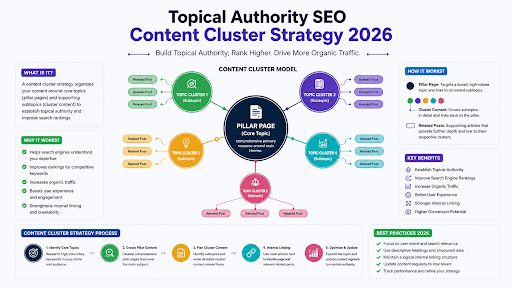
Then build a pillar page for your main, comprehensive post on the topic. It covers the big picture and links out to all your supporting articles.Those supporting articles are your cluster content. Each one goes deep on a single piece of the topic. Every cluster post links back to the pillar. They also link to each other where it makes sense. That network of posts is what tells Google you’ve actually covered the subject.Don’t link randomly. Every cluster back to the pillar. Pillar out to every cluster. This is what helps Google crawl your site and understand how it fits together.
Keep things updated too. A 2021 post with stale information pulls your authority down. Check your content regularly, swap in fresh data, cut anything that’s no longer accurate. For the next step, our guide on how to write a pillar page covers structure, length, and internal linking in detail.
Content Clusters for SEO: How It Actually Works
Instead of writing whatever seems relevant that week, you organize everything around one central idea.Say your site is about digital marketing. Your pillar might be “The Complete Guide to SEO.” Your cluster posts cover keyword research, on-page SEO, link building, technical SEO, local SEO each going deep, all linking back to the pillar.
When everything connects, people stay longer. There’s always somewhere logical to go next, so they don’t leave. And Google starts seeing your site as the place to go for this topic.The sites dominating Google right now aren’t publishing the most. They’re publishing the most connected, relevant content within one focused area.
Mistakes That Quietly Kill Your Authority
Writing about too many unrelated topics is the big one. If your blog jumps between fitness, finance, travel, and recipes, Google can’t place you as an expert in anything. Pick a lane.Shallow posts are an underrated ranking killer. A 300-word post that barely says anything doesn’t just fail readers. It tells Google your coverage is shallow. Every post should add something real.
Forgetting internal links is a quiet killer. You can have solid content and still confuse Google if your posts float in isolation. Connect them on purpose.Random backlinks from unrelated sites do almost nothing. A couple of links from sites in your actual niche sites covering the same subject will move the needle faster than a hundred generic guest posts.
Where to Focus Your Topical Authority SEO Strategy in 2026
Start with one subject. Just one. Go deep before anything else. Write the pillar page first. Then build the cluster posts around it, one at a time. Before you guess at topics, pull up Google Search Console or Ahrefs. What people actually type into Google is usually different from what you’d assume. Your assumptions are usually wrong.
This isn’t a two-week strategy. Results show up over months, sometimes longer. But once topical authority is there, competitors can’t easily take it from you and that’s what makes the whole thing worth doing.
Conclusion
Topical authority SEO isn’t new. It’s just finally impossible to ignore.Stop thinking keyword by keyword. Start thinking about owning a whole subject. Write content that connects, link it properly, and go deeper on your topic than anyone else has bothered to.Want to build something that holds? Best Digital Marketing Trends is where serious marketers are already looking.
FAQ
What is topical authority in SEO?
It’s how well Google sees your site as an expert on a specific subject. You build it by publishing deep, connected content that covers a topic from multiple angles, not just one or two posts.
How do I build topical authority fast?
Start with a topic map, create a pillar page, and write cluster content around it. Link everything on purpose. Focus on one subject before expanding.
Is topical authority better than domain authority?
They do different things. Domain authority measures overall site strength. Topical authority measures depth on a specific subject. Right now, topical authority does more for your rankings than almost anything else, especially if your site is newer and doesn’t have years of backlinks behind it.
How many posts do I need?
No magic number. What matters is coverage and quality. For most niches, somewhere between 15 and 20 posts properly linked, actually useful gets you moving in the right direction.
Does topical authority help with AI search results?
Yes. Google AI Overviews and tools like ChatGPT pull from sources they trust as subject experts.


