
Now think about your last successful post. It took a whole week to create it; you published it, shared it once, and just observed how it disappeared into oblivion. Two weeks have passed since then, and now you’re looking at your empty calendar, having no idea what to write next.
However, your post still exists somewhere, while most of your readers haven’t even seen it yet. A proper content repurposing system would allow you to turn one good post into a few. Here’s what my approach would be like.I haven’t run these steps for your business, so treat this as a starting plan. When a fact comes from an outside source, I say so. The rest is my own view.
What repurposing really is
You take an idea you already made and reshape it for a new format, channel, or audience. A how-to post turns into a short video. A webinar turns into a handful of social posts. A podcast turns into a written summary. The idea stays put, and only the packaging changes.
What it isn’t is copy and paste. HubSpot’s guide on repurposing content, marked as updated 05/09/25, tells you to start by “taking a look at your metrics.” It calls simply re-sharing an old post with a new description, “lazy.” And it reminds you that repurposing “isn’t meant to be an alternative to creating new content.”
Start with the winners.
Do not recycle all content. Begin with what you have working. As per the HubSpot guide, it mentions some of the best performing pieces and suggests that the old content that generates traffic or leads and competes for high-value keywords can be recycled. So, begin with analyzing your numbers. What kind of posts generate consistent views or comments or signups?In my experience, I always go for the content that has an evergreen quality.
Give every version a job.
Here’s where a content repurposing strategy usually falls apart. People crank out ten versions with no reason behind any of them. Before you make a single one, ask what it’s for. Maybe it should bring readers back to the original. Maybe it should introduce your brand to people who never read blogs. Maybe it should answer a question customers keep asking.Write the goal in one line. If you can’t, skip that version.
Match the format to the idea.
Different ideas suit different formats. HubSpot offers a few examples.How-to blog posts may become images or videos, while data-driven posts may turn into infographics. Posts may become slide presentations or ebooks. Quotes can be shared through social media, while video/webinar transcripts may become post articles.
What works for me is asking myself: “What is this post made up of? If it’s about a process, it can turn into a checklist or a video clip. If it’s about numbers – it can become a chart. If it’s a story, it may become a short tweet thread or an email message. If it’s an argument – divide it into several parts.”If your post is about search, our SEO marketing section has related ideas that pair well here.
Rewrite it; don’t just copy it.
Each one needs to fit its habitat. A sentence that makes sense in a blog could seem overly formal in a short video. So you need to cut it down, make it simpler, and go right for what interests that particular audience.
Also, don’t use the exact same words everywhere. Aside from being mechanical, it also creates problems for search engines, which brings us to our next point.
Watch out for duplicate pages.
If you republish full articles on other websites, search engines may see near-copies. Search Engine Land reported on Google’s help documentation about syndicated content. It says the canonical link element “is not recommended for those who wish to avoid duplication by syndication partners,” because “the pages are often very different.” Google says, “The most effective solution is for partners to block indexing of your content.” The paper does not offer details on how one should go about doing so and also acknowledges that sometimes it may not be possible to make a partner do so. There also is no publication date on the paper, so it is important to verify the information from Google’s current documentation.
How does it apply in the day-to-day life of using the strategy? In case of repurposing of content, it is important to be very careful whenever using the content from someone else’s website. Using a short summary together with the link will be better than using a full copy. That’s my own reading, so check with your technical team before doing anything big.
You can read Search Engine Land’s report on syndicated content for the details.
Make it a routine, then check the results.
The best way to implement a content repurposing strategy is through habit rather than one-off execution. The best way to do that is by publishing one main piece of content per month. Following that, publish several versions of this content over the coming weeks in different forms, such as a blog post, an infographic with a quote, and an email.
This tracking will make sure that your content repurposing strategy stays true to its course.Each version will have a purpose and its results, which will include the success of that piece of work in generating traffic to the original source or any comments and sign-ups made by potential customers. Soon, you will be able to recognize trends, and then concentrate on producing those pieces that were successful.
Small ways to begin this week
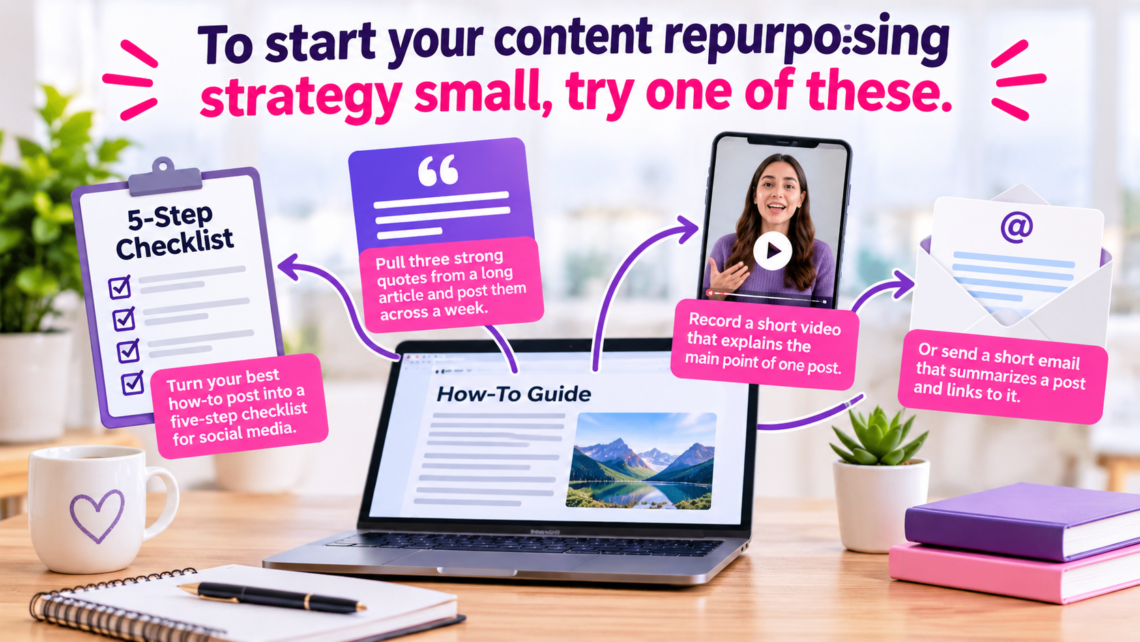
For a simple approach to content repurposing, you can choose any one of these approaches. Convert the most engaging how-to blog post you have into a five-point checklist on social media sites. Select three compelling quotes from an article and post those over a week’s period of time. You can also record a video that explains the key message of a blog post.
Where people slip
The most serious mistake while implementing content repurposing is repetition of the same content again and again. Other mistakes include selection of poor quality content, forgetting to specify the purpose of every version, forgetting to use backlink to the original content, and neglecting the outcome assessment.
It is important to pay attention to quality. It does not mean that repurposed content can be weak – if it is, the original should be improved. In addition, remember to update all facts. If your old post contains outdated information about some regulation, price, or tool, correct it before repurposing.
Your next step
Go to your analytics and select your top three posts from the last year. Select one. List the objective, select two new formats, and select the date to release the first version.
For more inspiration on how to reach your audience, visit our Content Marketing page. A successful content repurposing strategy approach does not have to be complex: just select your winners, define their purpose, rewrite for the format, and analyze the results.
FAQ
What is a content repurposing strategy?
It’s a plan for reshaping content you already made into new formats or channels, like turning a blog post into a video or an email.
Is repurposing content the same as duplicate content?
It is a plan for changing content that you have created into different forms, for instance from an article to video or email.
Is there a difference between repurposing and duplicate content?
The answer is yes. Repurposing changes the form and language of content. Duplicate content is making copies of entire articles on other sites.
What content do I need to repurpose first?
Repurpose those articles which have performed well and are of value over time. For instance, how-to articles.
How often should I repurpose content?
It depends on your capacity. Many teams start with one original piece a month and a few smaller versions in the weeks after.
Does repurposing replace new content?
No. HubSpot’s guide says to use repurposing alongside new content, not instead of it.

