
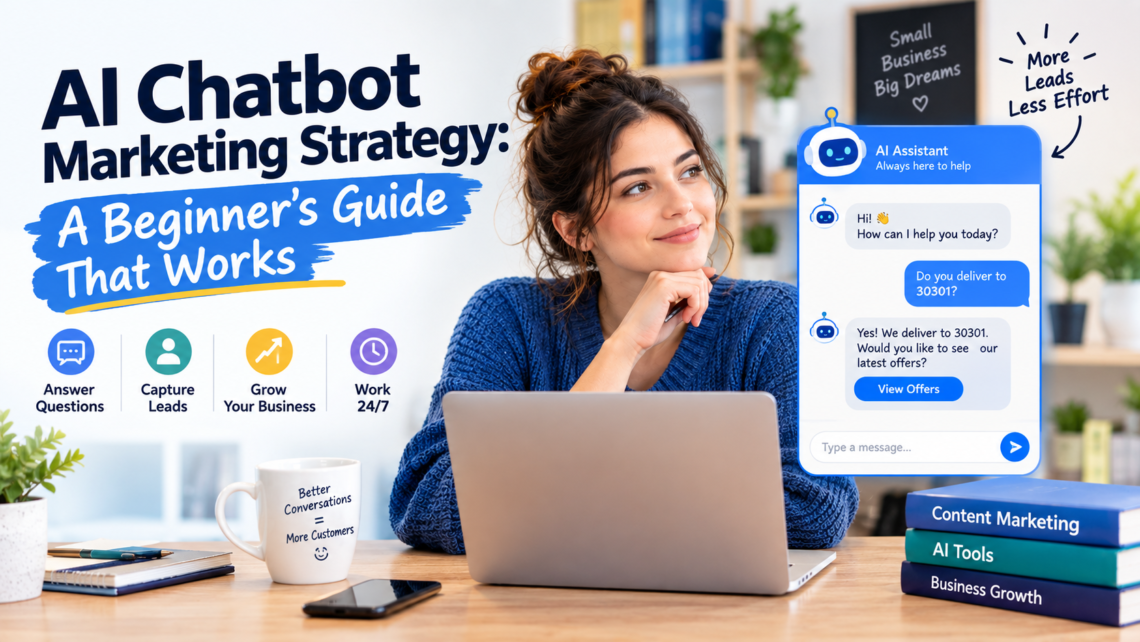
You talked to a chatbot this week. Probably didn’t even clock it. Asked a question on some website, got an answer back in a second or two, maybe got handed off to a real person after. Five minutes later you forgot it happened at all.And which, truth be told, is the whole purpose. A well-programmed bot does not seem to be a bot at all. It seems as if you received your information and carried on.
Flip that around for a second. You run a small business. That same tiny piece of software can answer a customer’s question at 2am while you’re asleep, grab their email before they bounce, and never once call in sick. That’s basically the entire pitch behind an AI chatbot marketing strategy. And no, it’s not nearly as complicated as the vendor websites make it sound. Those sites have a reason to make it sound complicated. You don’t have to buy that.
What Is an AI Chatbot Marketing Strategy?
If you remove all the hype from chatbots, what you are left with is just a script that responds to the messages you receive, allowing you not to have to respond to every single message received. For instance, if a person visits your site at 11 pm and asks “Do you deliver to 30301 zip code?”, they will receive a prompt answer without having to wait for you to manage your email.
Furthermore, an AI chatbot marketing strategy starts the moment you use that conversation for any other purpose than just a Q&A. You can request an email address before sharing the discount code or ask several quick questions and direct the visitor to the page that matches their interests. If done correctly, the whole thing won’t feel like filling out a questionnaire but rather a conversation. People usually tend to complete such conversations but close pop-ups of forms without any hesitation.
Why Use AI Chatbots for Marketing?
A form just sits there. Silent. Most people scroll right past it. A chatbot pops up and asks something specific, and specific questions get answered a lot more often than an empty text box ever does. There’s something about being asked directly that people respond to.
Here’s the thing most vendor pages conveniently leave out: bots are great for repetitive stuff and pretty bad at anything complicated. If most of your inbound messages are some flavor of “what are your hours” or “how much is this,” a bot eats that for breakfast and frees you up for the conversations that actually need a human brain behind them. That’s the real payoff. Not some vague “24/7 engagement” line pulled from a slide deck.
How to Build an AI Chatbot Marketing Strategy
Forget the fancy strategy documents for a minute. Start with the questions you already get asked, over and over, the ones you could probably answer in your sleep. Pull up your email. Check your DMs. If you still get voicemails, check those too. Write down the five things you find yourself repeating constantly. That’s your bot’s entire job on day one.Don’t try to make it do everything; it will be even worse at all of them if you try to get it to do fifty.
Choose an interface that your customer is using rather than one that is easiest to program. Got lots of website traffic? A widget is perfect for you. Living your life on Instagram? Your chatbot works much better than a link that’s several clicks into a rarely visited page.
Answer the questions in a similar manner as if attended to someone at the counter of the shop. For example, instead of writing “Thank you for contacting us,” you may write “Good question, the answer is right here”.
And provide it an escape route. Provide it with a clear and readily available method of talking to a real person. There is nothing more dispiriting than having a bot go round in circles because the question cannot be answered.
How to Turn Chatbot Conversations Into Leads
This is where it stops being a glorified FAQ page and starts earning the word “strategy.” Ask for contact info partway through, not the second someone opens the chat window. Nobody’s handing over their email before the bot’s proven it’s worth talking to.
Offer something in return. A code, a free guide, something that feels like an actual trade instead of a data grab. Then follow up like a human would. One well-timed message, not five automated emails crammed into three days that make people regret ever typing their email in the first place.
Keep an eye on what people actually type into the bot. That log is basically a free list of blog topics and FAQ answers waiting to be written, because it’s a direct window into what’s confusing your customers right now, today, not six months ago when you last updated your website copy.
Common AI Chatbot Marketing Mistakes
Pretending the bot is human. People figure it out within about two messages, and once they feel tricked, that trust doesn’t come back easy. A plain “Hi, I’m an automated assistant” at the start heads this off completely, and nobody actually minds once you’re upfront about it.
Building it once and never touching it again is the other big one. Questions shift. New products launch. A bot running on six-month-old answers starts feeling more useless than no bot at all, and people notice that fast.
Skipping the human escape hatch, already mentioned above but worth repeating because it’s that common a mistake, leaves people stuck and annoyed, and that annoyance sticks to your whole brand, not just to the little chat window in the corner. Salesforce’s research on chatbot marketing makes basically the same point, that the strongest setups pair automation with an easy path to an actual person rather than trying to replace one entirely.
There’s a content angle here too that gets skipped a lot. Botpress points out that chatbot marketing tends to work best across the whole funnel, not as one bolted-on widget, catching leads early, nudging them along in the middle, and helping close things out near the end.
Getting your first one live
Five questions. One platform. Answers written in your own voice, not some borrowed corporate one. A working way out to a human. Launch it small, watch what people type at it for a couple weeks, then adjust based on what actually shows up, not what you guessed would show up.
More practical guides like this live in our AI marketing tools section, or browse the full blog library if you want more of the same.
FAQ
Do I need to know how to code to set one of these up?
Not really. Almost all of today’s platforms are drag-and-drop platforms for those who have not done coding even once, and hence you will be able to configure your frequently asked questions without any knowledge of programming.
What does this actually cost to get started?
A lot of tools offer free or cheap starter plans that cover the basics, answering FAQs, and grabbing an email. Prices climb once you want fancier stuff, like running the bot across multiple platforms at once.
Is this going to replace my customer service team?
No, and honestly it shouldn’t try to.It takes care of the boring tasks, so that your own team can focus on having more complex discussions that require human insight.
How do I even know if it’s working?
Take note of how many discussions result in a written email, the inquiries are made, and deals are made. If people consistently go back to seeking out a real person to talk to, that’s a clear sign that the machine’s answers require some improvement.

