
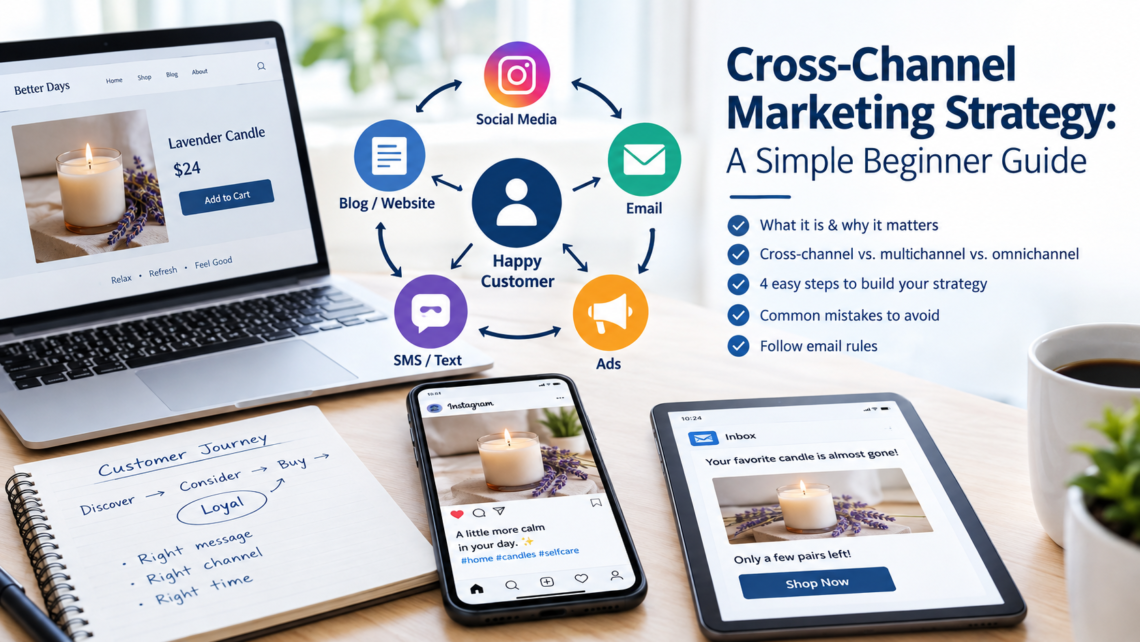
Ever look at a pair of running shoes on Instagram, close the app, and move on? Then two days later those exact shoes are sitting in your inbox. And a text says there are only a few pairs left.
Not a coincidence.That’s a cross-channel marketing strategy. Big brands do it, sure, but a one-person shop can pull it off with a notebook and a free afternoon.
What is a cross-channel marketing strategy?
It’s what you get when your marketing channels quit acting like strangers. Email, social media, the website, texts, and ads: they all know what the others are up to, and they know what the customer already did. Amplitude’s cross-channel marketing guide puts it as many channels working together on purpose. Fair enough.
My mental picture is a relay race. The customer is the baton. Instagram gets off to a running start, followed by email, and then the text race ends the race. If you drop the baton, the whole team loses.No plan? Then it’s four runners in four different races, and nobody’s passing anything.
Cross-channel vs. multichannel vs. omnichannel
These three get mixed up constantly, and the names don’t exactly help.
Multichannel is the messy one. You’re everywhere, but nobody compares notes.Email will be shouting about a discount on one item, whereas Instagram will be advertising another thing; a customer may think that there are two different companies.
Cross-channel will make it possible to connect your marketing channels together so they can exchange the information. For instance, a customer purchases a candle; everybody gets to know it.
Omnichannel is the dream version: phone to laptop to physical store, with no seams anywhere. It’s also pricey and needs a pile of tools. If you’re a small team, I’d skip it for now. Get cross-channel working first. You can grow into the rest.
Why a cross-channel marketing strategy is worth it
No one exists on a single platform. Your client will read your blog via laptop over lunch, scroll through Instagram sitting on the sofa, and check your emails while queueing for their morning coffee.
When the channels don’t talk, you burn money in dumb ways. Ads keep chasing someone around for the thing they already bought. A loyal fan gets a discount code they never needed. Annoying for them, wasteful for you.Connect the channels and it gets better quickly. Your message lines up from one channel to the next, and you stop guessing what the others are doing. Ad money goes further too.
Build your cross-channel marketing strategy in four steps.
You don’t need software. Pen and paper will do.
Step 1: Map the customer journey.
Grab a blank page and write down how people find you, then follow them around in your head. What do they click next? What do they read? Where do they quietly vanish?
That’s customer journey mapping, which is a fancy name for doodling. Ugly works fine.The small stuff counts. A newsletter signup is a signal. So is a cart somebody filled and then abandoned. Both basically say, “I’m a little interested.”
Step 2: Group people by what they do.
Age and job title can wait, because what people do tells you moreThere is a big difference between a person who visited your pricing page two times and another person who only read one blog article.First make three segments: first timers, buyers, and past clients. You can always add more segments in the future, if needed.
Step 3: Match the message to the channel.
Now decide who hears what and where. New visitors want something useful to read, not a pitch. Someone near the buying point might only need a nudge by email. Past customers? Say thanks and hand them a tip they can use.
Don’t use the same message for every medium at once because it feels complete but comes across as pushy. Plus, when somebody buys something, everybody better know it or you’ll be marketing to a prospect that’s already decided – kind of embarrassing.
Step 4: Measure and adjust
Clicks are fine, but they only tell part of it. What I care about more is whether the email helped close a sale that started on social media.Change one thing at a time. Two subject lines, say. Keep the winner, toss the loser, repeat.Need content ideas? Our content marketing strategy for small business guides covers that.
A simple cross-channel marketing example
Suppose you sell candles online and the price of a lavender candle is $24.Someone visits your blog post about gift ideas and subscribes to the newsletter. The welcome email shows your best sellers. She clicks the lavender candle, looks at it for a while, and leaves. No sale.
The next day, a short reminder shows up in her inbox. This time she buys.What makes it work is that every channel finds out. The ads for that candle stop following her around, and she starts seeing something that goes with it, a candle snuffer or a matching soap.That’s a small cross-channel marketing strategy at work. A spreadsheet and some patience get you surprisingly far.
Mistakes that wreck a cross-channel marketing strategy
Almost every mistake here comes from doing too much, too fast.Channels, for one. Everyone wants to be on five. Resist that. Two or three done well beats five done halfway.Voice, too. If your emails sound like a robot wrote them and your Instagram sounds like your funniest friend, people notice. Pick one voice.
Spam is the other big one. More messages doesn’t mean more sales. Imagine seeing the same offer on three apps in one day. You’d tune out, and some people would unsubscribe.Also, write down what you try. Guessing feels fast and costs a lot. A short note about what you did and what happened is plenty.
Follow the email rules.
Email usually holds a cross-channel marketing strategy together, so the law applies to you. The FTC’s CAN-SPAM Act compliance guide lays out the basics. Headers can’t be false or misleading. Subject lines can’t trick anyone. The message has to say it’s an ad and carry a real mailing address, and people need an easy way to opt out, which you have 10 business days to honor.
Slip up and it gets pricey. The FTC page says each email in violation can bring a penalty of up to $53,088. Hiring another company to send the emails doesn’t get you off the hook either. Read the page once, then check back now and then in case anything changes.
Your next step
Choose one task and perform it right away. Select two channels that you use. And choose one customer action, whether it is a cart abandonment or signup, which will act as a trigger for your second channel. Implement this and let it run for several weeks. Browse our content marketing guides. Start small with your cross-channel marketing approach and discover what two linked channels can achieve.
FAQ
What is the definition of cross-channel marketing?
The cross-channel marketing approach implies coordination between your channels aimed at achieving a single goal: an email, advertisement, and a post on social media guide your client through the same journey.
What distinguishes cross-channel from multichannel marketing?
In the multichannel marketing approach, several channels are used separately while in cross-channel marketing, channels are connected in order to exchange information about a client and be consistent.
Is cross-channel marketing suitable for small businesses?
Yes, and it doesn’t require a big budget; two channels, a customer journey map, and a spreadsheet is enough.
How many channels should be used?
Two or three channels are recommended. More channels can be added only if they are manageable.
Do you need tools for cross-channel marketing?
No, initially it will be enough just simple tools and tracking sheet. Further, you may consider using paid tools for cross-channel marketing.

