
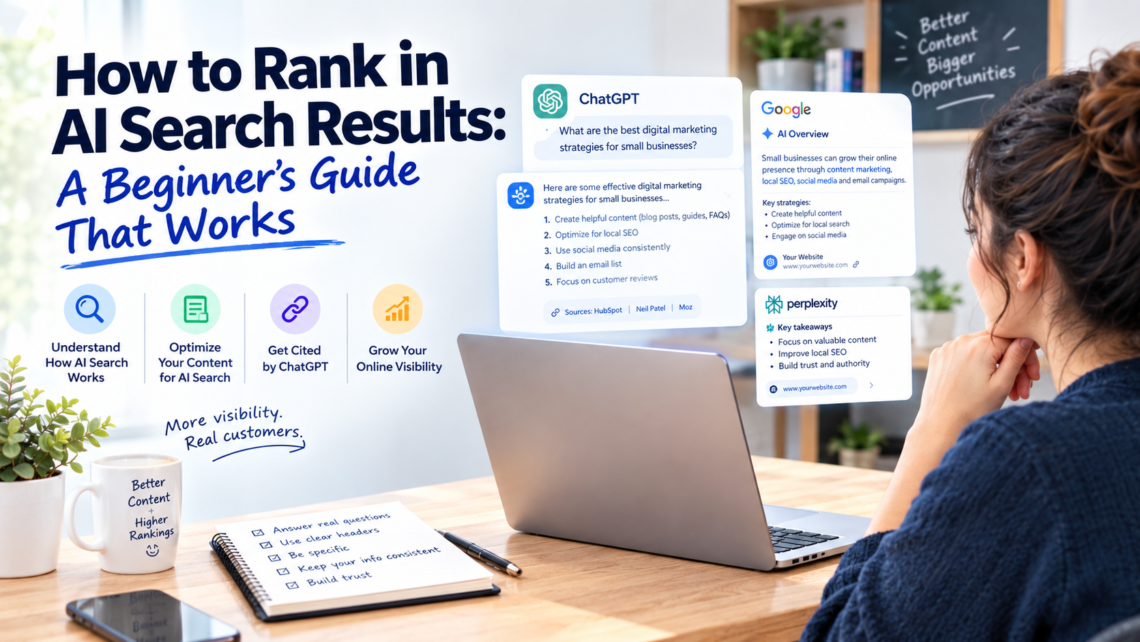
Type a question into Google lately, and half the time there’s already an answer sitting there before you scroll past it. No clicking required. It just tells you. Great if you’re the one searching, obviously. Not so great if you’re the business hoping that search sends someone your way.
So here’s the question I keep getting asked: how to rank in AI search results when there’s no neat list of ten blue links to fight your way onto anymore? It’s just one answer, stitched together from wherever the AI decided to look. The good part, if there is one, is that this isn’t some brand new discipline you have to learn from zero. Most of it is stuff you’re already sort of doing. You just need a few new habits stacked on top.
How Does AI Search Work?
Regular Google gives you a pile of links and lets you pick. AI search skips that whole step. ChatGPT, Google’s AI Overviews, and Perplexity all read through a bunch of pages, decided which ones actually answer the thing you asked, and mashed them into one direct answer. Sometimes it names where that came from. Sometimes it just quietly takes your wording and moves on without sending anyone your direction at all.
That second part annoys people, and fair enough, it should. But being the page an AI actually pulls from still counts for something. It builds a kind of trust even when nobody clicks through right away, and plenty of these tools do link back when they’re citing you directly instead of paraphrasing you into oblivion.
AI Search vs. Traditional Google Search
Ignore anyone telling you SEO is over. It’s not. AI search tools are mostly just reading whatever already ranks decently in normal search, then picking which bits to quote from that pile. If your page never shows up organically to begin with, there’s nothing for an AI model to even find, let alone quote.
Step one is still step one, in other words. Provide some real value. Answer the question that someone actually searches for on Google, rather than providing an answer to a diluted version of the question. Create some legitimate backlinks gradually instead of trying to buy a load of junk ones immediately. None of that changed just because AI showed up.When it comes to ai search vs google search, the ranking groundwork is still the same game.
How to Optimize Content for AI Search
This part’s a little different from writing for a person scrolling top to bottom on their phone.
Put your answer up near the top. Not three paragraphs into a windup nobody asked for. AI tools grab whatever answers the question fastest, and if your best line is buried at the bottom, there’s a decent chance it never gets touched.
Short paragraphs. Clear headers. AI models handle structured content way better than one giant block of text, same as a human trying to skim would. A page that reads like a novel with zero breaks is hard for anyone, human or otherwise, to find the useful part in.
Answer something specific, not a vague topic. “Digital Marketing Tips” as a title gives an AI tool nothing solid to grab. “How much does local SEO cost for a small business?” gives it an actual question with an actual answer; it can lift almost word for word.
And back things up with real detail. “Many businesses see results” tells an AI model nothing useful. Specific, honest information, the kind that sounds like someone who’s actually done the thing wrote it, gets pulled a lot more often than fluff does.This is the core of how to rank in ai search results: give the model something concrete enough to quote.
How to Get Cited by ChatGPT and Other AI Tools
There’s a real difference between an AI quoting you with a link attached and an AI just absorbing your wording with zero credit. You can’t fully control which one you get. A few things nudge the odds your way, though.
Keep your business info consistent everywhere. Same name, same address, same hours, matching across your website, your Google Business Profile, and wherever else you’re listed. These tools cross-check that stuff more than people realize, and mismatched details make you look shakier than whatever’s summarizing you.
Write as if you have a deep understanding of the topic instead of merely paraphrasing what the other fourteen websites have said. How can an AI possibly choose to use your web page about removing pet stains from carpets when you have the same five suggestions as everyone else’s pages on this topic? A detail from actually having done the work yourself.
AI Search Optimization Tips for Small Businesses
Site load fast? Works fine on a phone? Pages that load slowly and awkwardly are ignored by AI bots in the same way they are ignored by an individual who becomes impatient while scrolling through the website. Answer the common questions somewhere within your website, even if it’s at the bottom of the page in a small FAQ.
Markopolo’s research on this backs up the SEO point too; ranking organically is basically a prerequisite for showing up in an AI answer at all, since most of these tools pull from content that already proved itself in regular search first.
Addlly’s guide makes a similar point about structure, that AI tools tend to favor clear headers and scannable answers over long blog posts that bury the useful part somewhere in paragraph seven.
How to Start Optimizing for AI Search
Pick one page on your site that already pulls some traffic. Rewrite the opening so it answers the actual question in the first sentence, not the fifth paragraph. Break up any dense text blocks. Add a short FAQ if you don’t have one. That’s a real place to start, and none of it requires learning some whole new field overnight.
More practical guides like this live in our SEO section, or browse the full blog library for more of the same.
FAQ
Is AI search going to replace regular Google search?
Not entirely, not yet anyway. There is co-existence of AI introductions and tools such as ChatGPT with normal search results rather than the former dominating the latter; hence, both are equally important.
Do I need to add special code to my site for this?
Helps, but it’s not the first thing to worry about. Clear structure, direct answers, and consistent business info matter more early on than something like schema markup.
How’s this different from regular SEO?
Regular SEO is about ranking a link on a results page. This is about being the source an AI model actually quotes when it builds its answer, which rewards being clear and direct even more than regular SEO already does.
How long before I show up in AI search results?
No fixed timeline here. Because these services mostly utilize data from pages that perform well in the organic search process, the results will be reflected together with the results of your ongoing SEO work.


