
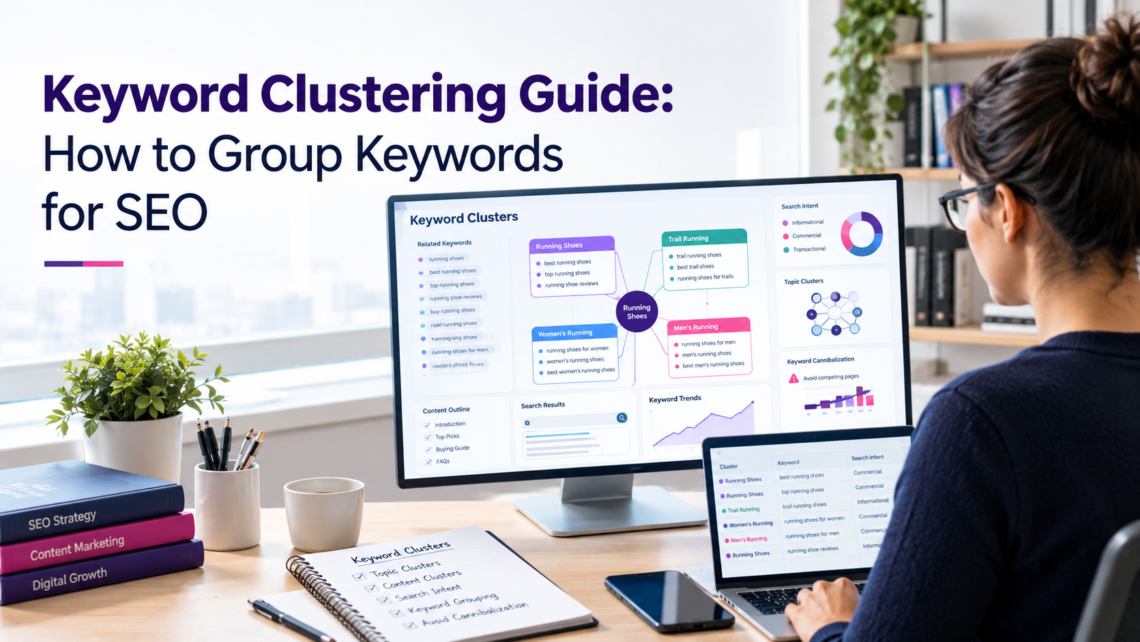
A small business writes three blog posts in one month. “Best running shoes.” “Top running shoes.” “Running shoe reviews.” Put them side by side and, honestly, they’re saying the same thing three different ways. Six months later none of them rank on page one. They just sit there, quietly fighting each other for the same spot in Google. I run into this all the time, and it’s the exact problem a decent keyword clustering guide is supposed to fix.
What Is Keyword Clustering?
Keyword clustering, at its core, is grouping keywords that a searcher would accept the same answer for, then building one page that covers all of them. You stop writing a fresh page for every keyword on your list. Instead, you ask a simpler question: would the same page satisfy someone searching any of these terms? If the answer’s yes, group them.
Back to the running shoe example. Those searching for “best running shoes” have the same objective as those looking for “top running shoes.” There is no difference in meaning.One page, with actual opinions and specific picks in it, can carry all three searches at once.
That’s the whole idea behind a keyword clustering guide that’s actually worth following. Stop chasing keywords one at a time. Start grouping them by what the person typing them actually wants.
Why One Keyword Per Page Stopped Working
There used to be a trick here. Stuff “running shoes” into a page fifty times and you’d probably rank for “running shoes.” That stopped working a while back, and it’s not coming back.
Google reads a page closer to how a person would now. It checks whether the page actually answers the question, not how many times a phrase gets repeated. With five skinny pages all revolving around the same subject matter, Google ends up confused on which page to show, resulting in none of them doing well. This phenomenon has its own term within SEO—keyword cannibalization. And it’s one of the less discussed causes of stagnated traffic despite regular posts.
Group the related terms instead. One strong page usually beats five weak ones, and it’s not close.
How to Find Keywords to Cluster
Before grouping anything, you need a list to work from. Here’s roughly how I build one.Start with a seed keyword, the broad term sitting at the center of the topic. Type it into Google, and look at the autocomplete suggestions. Scroll to the bottom of the results and check the related searches box too. Both are pulled straight from real queries people type in every day.
A keyword research tool speeds all this up, pulling in hundreds of related terms plus rough search volume for each. You don’t need a paid one to start. A free tool works fine once you’ve got fifty or so terms in front of you.
Types of Keyword Clusters
Clusters don’t all get built the same way. Three approaches show up most often in practice.Group by intent, and you’re sorting keywords by what the searcher wants to do: learn something, compare a few options, or buy right now. “How does keyword clustering work” and “keyword clustering steps” both come from someone still learning, so they end up in the same bucket.
There’s also grouping by the search results themselves. Check which pages already rank for a batch of keywords. If ten different terms all pull up the same three articles near the top, Google’s already telling you they’re one topic. Might as well treat them that way.Then there’s the bigger version of this, the topic cluster. Rather than clumping a few key phrases into a single page, create a large pillar page and link out to small pages focused on one aspect at a time. It takes time, but those that do it usually have better success in the long run with building authority.
Following a structured keyword clustering guide at this stage saves a lot of cleanup later, once you’ve already published a dozen pages that overlap.
Steps to Build a Keyword Cluster
- Gather every keyword related to your topic, using the methods above.
- Sort by intent. Separate the “just learning” searches from the “ready to buy” ones.
- Group whatever terms the same page would actually satisfy.
- Pick one keyword per cluster as the main focus.
- Assign the cluster to a single page or a pillar page with supporting pages for bigger topics.
- Make sure your page addresses all the questions in the cluster, not just the main topic.
This won’t be hard after a few tries. Your first cluster might take all afternoon to complete. But by the fifth or sixth one, you’ll be able to identify the clusters without even using a spreadsheet program.
Common Mistakes to Avoid
The mistake I see most is grouping keywords that sound alike but aren’t. “Running shoes for flat feet” and “running shoes for trail running” share half their words, but whoever’s searching each one wants something different. Cram them onto one page, and both readers walk away half answered.
Building a cluster once and never touching it again is another one. Search habits shift. New questions pop up that didn’t exist a year ago. A cluster from two years back is probably missing terms people search for right now.
Skipping the intent check causes real problems too. Mix informational searches with transactional ones in the same cluster and you get a page trying to be a guide and a sales pitch at the same time. It rarely pulls off either.
Tools That Help With Clustering
A spreadsheet and some patience gets you through small clusters just fine. Past a handful of pages, though, a dedicated tool saves hours. Options like Surfer SEO, Keyword Insights, and SE Ranking’s grouping tool scan a keyword list and sort it automatically based on shared search results. Google’s own Keyword Planner is a solid free starting point for building that initial list before sorting it into anything.
Want the technical version straight from the source? Google’s Search Central documentation covers how it evaluates page quality and relevance in more depth than fits here.
If you’d rather have someone build the strategy alongside you, our team at Best Digital Marketing Trends does this with clients regularly, and we’re glad to take a look at your existing content for overlap.
Wrapping Up
Quick summary of this guide to keyword clustering: keyword clustering is not a new trend but simply how search engine optimization works in the era where Google evaluates your page based on how helpful it is to the user. Pick one topic, collect the keywords that cluster around it, categorize them based on intent, and create one page that deserves it rather than five pages that don’t. Do it a few times and watch yourself rank higher.
If your website has some existing posts that overlap with each other, start with them. Group what already exists before writing anything new. Best Digital Marketing Trends can take a second look with you if you want another set of eyes on it.
FAQ
What is the difference between keyword clustering and topic clusters?
The concept of keyword clustering is concerned with bringing together all the search keywords with the same intent in one single page. The topic cluster operates on a wider scope whereby one pillar page covers an entire subject and links to other pages that deal with specific parts of that subject.
How many keywords should be in one cluster?
There’s no fixed number. Some clusters have just two or three closely related terms. Others have twenty or more. It comes down to how many keywords actually share the same search intent, not hitting some target count.
Can I do keyword clustering without a paid tool?
Yes. A spreadsheet, Google’s autocomplete and related searches, and the “People Also Ask” boxes are enough to build clusters by hand for a small site. Paid tools mostly save time once you’re working through hundreds of keywords at once.
How often should I update my keyword clusters?
Three to six months is a good time frame to check up on things for most websites. There are changes in search trends and new questions arising, and some terms from a one-year-old cluster may need to be added.

