
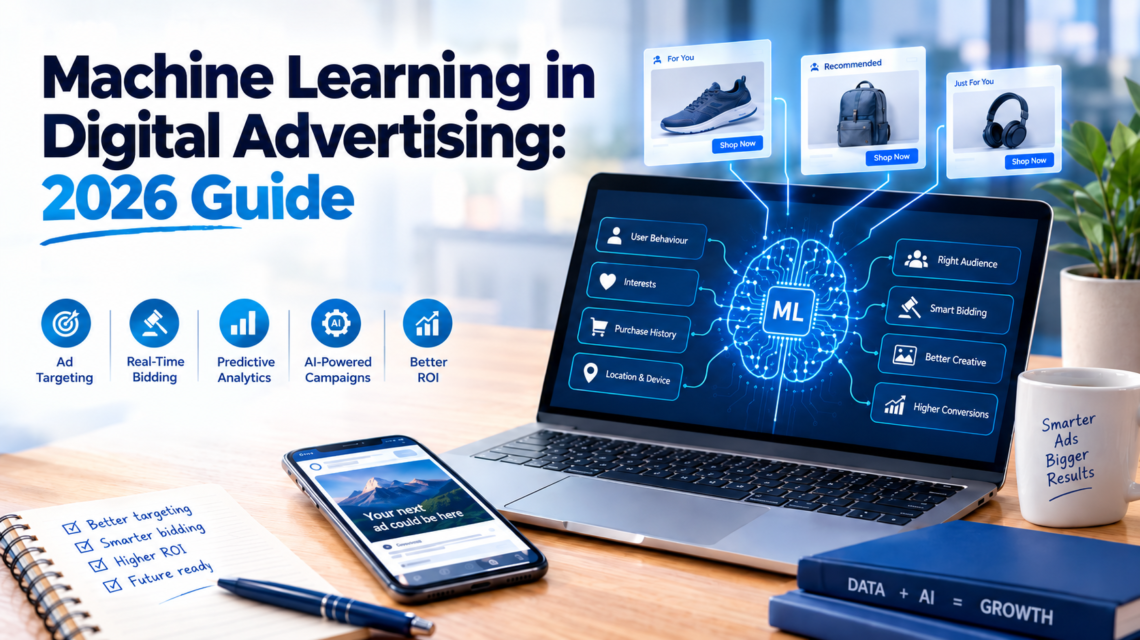
Almost every ad you scroll past today got picked for you by a machine. Not a person. Somebody wrote the rules once, years ago, and then handed the whole job over to software that’s been quietly grading your habits against everybody else’s ever since.
You’re worth showing that sneaker ad, or you’re not. The math happens in under a second.That’s machine learning in digital advertising. Sounds like a buzzword. It isn’t one anymore; it’s just the plumbing behind every ad you see, on every page, whether you notice it or not.
So what’s the machine doing with all that? Where does it help, and where does it just make the same old mistakes faster, just at a bigger scale? That’s the rest of this piece.
What Machine Learning Actually Does in Digital Advertising
Beyond the fancy talk, it’s simply a matter of pattern recognition, but on a scale that a group of humans would never be able to achieve. The program looks at everything that people have clicked on, purchased, skipped, or lingered on, and then makes predictions based on all of that data that it is accumulating. And it does so literally millions of times per second in real-time.
Four jobs eat up most of that work. Who sees the ad? How much to bid for the slot. Catching fraud before it burns through a budget. And, after the fact, tracing which sale came from which ad is the part known in the industry as attribution.
Google’s Performance Max and Meta’s Advantage+ are basically built entirely around this now: automated bidding, automated placement, and automated everything. None of it existed twenty years ago. A media buyer just picked a magazine and hoped.
Machine Learning Ad Targeting: How It Picks Who Sees What
“Women 25 to 34” is yesterday’s crude categorization tool. ML-driven advertising target profiling relies on a rolling combination of online behavior, previous buying history, time of day, your device, and a score of other small variables that no one bothers to mention. That profile updates basically every time you click anything. Two people who technically fit the same demographic box can end up seeing completely different ads, because what they’ve actually been doing points in different directions.
Less wasted ad spend. Fewer irrelevant ads clogging your feed. Fine, that part’s genuinely good.The catch is the pile of personal data underneath all of it, which is exactly why regulators keep circling back to this space.
Programmatic Advertising Machine Learning Runs On
Programmatic advertising, stripped down, is just automated buying and selling of ad space. Machine learning makes those auctions run fast enough to matter at all. This movement has been studied by the Interactive Advertising Bureau and according to their data, programmatic makes up around 90% of worldwide digital display ad spending, and that part based on artificial intelligence increased by 18% annually to exceed $130 billion mark.Not a corner of the industry anymore. Pretty much the whole thing.
Every time a webpage loads, an auction fires off in the background. An algorithm decides who wins the slot. The winning ad shows up before the page even finishes loading.These occur thousands of times per second at one busy website, yet the observer of the web page is totally unaware that anything happened.
Predictive Analytics Marketing: Seeing Trends Before They Happen
Predictive analytics marketing looks at what someone’s done before to guess what they’ll do next. Abandon a cart. Cancel a subscription. Come back and buy again. Retailers use it to time discount emails so they land right before someone loses interest. Subscription companies use it to catch an account before it churns, not after.
It’s not fortune telling, no matter what the sales pitch says. It’s probability, and probability is messy by nature. A model might say a customer has a 70% chance of buying again inside two weeks. Marketers act on that number knowing the model gets it wrong a fair amount of the time. It just has to beat a coin flip. Usually it does.
AI-Powered Ad Campaigns: What the Numbers Actually Show
The dollars themselves say a portion of the tale. Total global spending on artificial intelligence in advertisements was approximately $11 billion in 2025 and is projected to be close to $14 billion in 2026. An analysis revealed that artificial intelligence-generated ads resulted in an increase in clicks by nearly 47% when compared to human-only generated creative.
But bigger numbers don’t mean better campaigns, not automatically. A lot of that spend is going toward experiments that go nowhere, and plenty of AI-assisted campaigns still flop because whatever idea was driving them wasn’t strong to start with. Machine learning can optimize a bad idea faster than a person ever could. It cannot turn that bad idea into a good one. I wish more people signing off on these budgets understood that going in.
Machine Learning ROI Marketing Teams Can Actually Measure
Ask ten agencies about ROI here and you’ll get ten different answers. Everyone measures it a little differently. Some report real gains: better conversion and lower cost per lead. Others don’t.
Research on AI projects broadly has found failure rates above 80% for actually delivering the value promised at the pitch meeting. Eighty percent. That number should give anyone pause before signing a contract based on a demo.
Most of the gap comes down to data quality and whether anyone bothers to keep tuning things. A model is only as good as the data used to train it, but many organizations use inaccurate, incomplete, and out-of-date data and then get shocked by the poor performance of the model. Agency professionals have told me that when their model failed to meet their needs, they blamed it on the algorithm without realizing that there were three years of duplicated customer data that hadn’t been cleansed. Successful models are the ones that are continually improved after initial data cleansing.
Where Machine Learning in Digital Advertising Is Headed
Creative production and targeting keep getting closer together, so ads get built and adjusted for specific audiences almost automatically now. More scrutiny is coming too. The FTC has published guidance on how AI-driven ad platforms need to handle consumer data and disclosure, and that oversight only grows as the technology spreads further into everyday marketing work.
Want a closer look at how these shifts are playing out on specific ad platforms? bestdigitalmarketingtrends.com‘s breakdown of machine learning in digital advertising tracks it as it happens, which matters in a space that moves faster than most guides can keep up with.
The Bottom Line
Machine learning isn’t replacing marketers.And that is putting an end to the process that would take up all of their time. It takes care of things such as targeting, bidding, and pattern recognition on a scale that cannot be achieved manually by anyone, yet someone needs to determine the message of the campaign.
Clean data, good strategy, and machine learning in digital advertising become a valuable asset rather than an unnecessary experiment. Skip either one and you’re just paying more to fail faster. For more on how marketing teams are putting this into practice, bestdigitalmarketingtrends.com has ongoing coverage worth following.
Frequently Asked Questions
What is machine learning in digital advertising?
It is the ability of software to analyze statistics and determine optimal advertising decisions.
How is machine learning ad targeting different from regular targeting?
Traditional targeting categorizes people into a large group whereas machine learning creates a user’s profile based on their continuous activities, resulting in the fact that two people from the same niche may receive different advertisements.
Does AI actually improve advertising ROI?
Sometimes. Depends a lot on data quality and whether anyone’s tuning the model over time, versus just turning it on and forgetting about it.
Is programmatic advertising the same as machine learning?
No. Programmatic is the automated buying and selling of ad space itself. Machine learning is the technology making the decisions inside those auctions.
Will machine learning replace human marketers?
Not anytime soon, honestly. It’s great at the repetitive, data-heavy grind. Strategy, brand voice, and creative direction still need an actual person.

